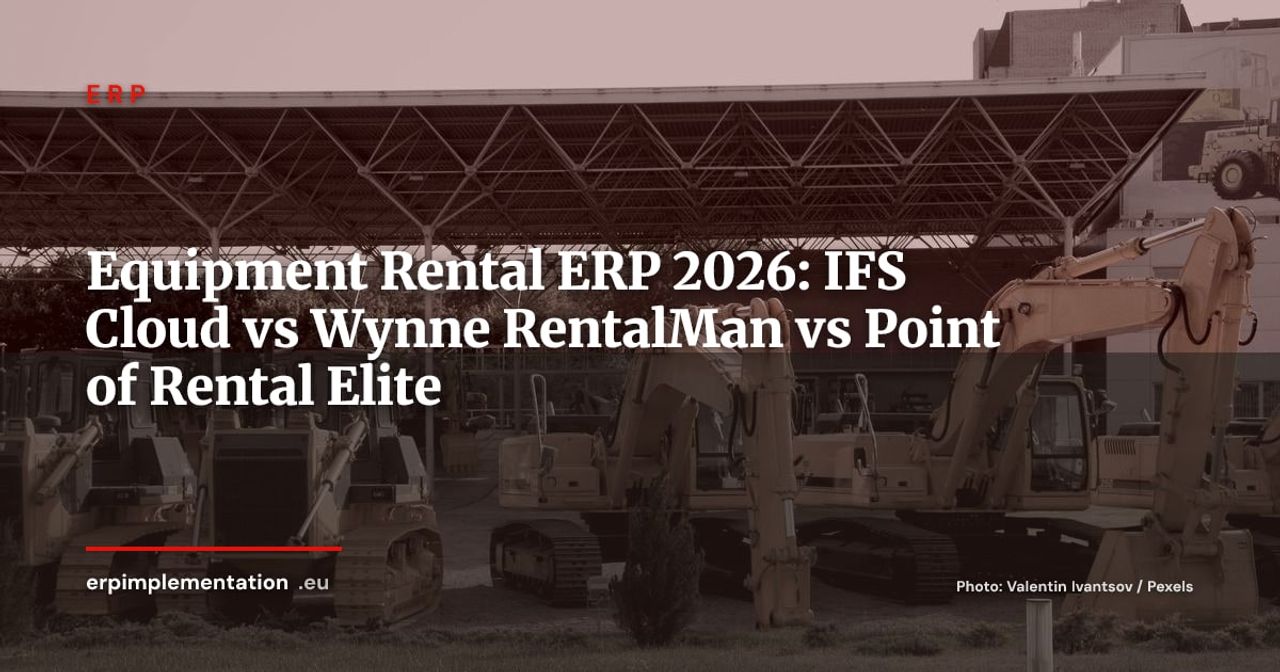
An equipment rental company does not manage sales. It manages availability windows, fleet rotation, servicing schedules, returns, and contracts that trigger by the hour or the week. This operational model is fundamentally incompatible with a generic ERP built around the classic order-delivery-invoice workflow.
Yet most small and mid-sized rental businesses still run on makeshift stacks: an accounting package, a spreadsheet for availability, and a messaging app to coordinate deliveries. That patchwork holds — until the first serious incident. A double booking on a £2,000-per-day platform lift. A statutory inspection overdue on a crane. A machine stuck on a customer site that refuses to return it.
This guide compares the specialist ERP platforms and rental management software available in 2026, from SME-scale tools to solutions built for large multi-depot fleets, with the functional criteria that actually matter in day-to-day operations.
Why Generic ERPs Fail Equipment Rental
Real-Time Availability — The Non-Negotiable Requirement
A sales ERP manages stock. An item ships out, inventory drops. Simple. Rental is fundamentally different: the asset comes back. Availability is not a fixed quantity — it is a function of time. An excavator on hire Monday through Friday is available again Friday evening. If a customer wants to reserve it from Thursday for the following week, the system needs to know it will be free, that no service is due before it can go back out, and that it can be delivered to the requested site on time.
No standard stock module models this. Generic ERPs that try to adapt introduce fragile workarounds: “return” orders to simulate restitutions, serial numbers pressed into service as status flags. The result is a complex database, prone to data entry errors, unable to answer the one question that defines the business: “What do I have available next week?”
Duration-Based Billing: An Underestimated Complexity
Time-based pricing breaks standard commercial logic. Rental companies typically apply decreasing rate structures: the daily rate is higher than the weekly rate divided by five, which is higher than the monthly rate divided by twenty-two. A single machine might be billed by the half-day, the week, a fixed-price project rate, or a long-term contract with a bundled maintenance allowance.
The pricing engines built into generic ERPs handle simple tariff structures — customer discounts, volume tiers, negotiated prices. They do not natively manage duration rate tables, automatic contract extensions, hour or mileage thresholds, or rate revision clauses tied to industry indices. Every adaptation means custom development, technical debt, and migration risk at each upgrade cycle.
Core Functional Requirements for Equipment Rental
Before comparing platforms, it is worth mapping the functional scope that distinguishes a genuine rental management system from a patched generic ERP.
Availability and Reservation
The availability engine needs to manage multiple dimensions simultaneously: gross availability (the asset exists and is not out of service), net availability (it is not already reserved for the requested period), logistical availability (it can be delivered to the site on time), and technical availability (it is current on all statutory inspections and certifications). If any of these four parameters is unmet, a confirmed booking becomes a customer incident.
Return Logistics and Route Planning
Rental logistics flow in both directions. Every delivery generates a collection to plan. Driver routes must account for site access constraints (operating hours, load limits, dimensional restrictions), commercial priorities (urgent jobs, key accounts), and route optimisation. This transport dimension is rarely covered by a generic ERP without a dedicated TMS module or specialist connector.
Usage-Based Preventive Maintenance
Equipment maintenance in rental cannot be scheduled purely by calendar. It depends on actual usage: engine hours, mileage, operating cycles. A compressor rented intensively for a month may reach its oil change threshold before one rented occasionally over six months. The ERP must integrate machine counters, trigger preventive work orders automatically, and block the asset’s availability during the maintenance window.
In many jurisdictions, lifting equipment is subject to mandatory periodic inspections — LOLER (Lifting Operations and Lifting Equipment Regulations 1998) in the UK, and equivalent national regulations across the EU under the Machinery Directive (2006/42/EC). A rental company that deploys equipment with an overdue statutory inspection is legally liable in the event of an accident. The software must trigger inspection alerts before expiry, block rental if certification is not current, and archive compliance records.
Deposits, Insurance, and Damage Liability
The rental contract generates specific financial flows: a security deposit collected at asset handover, returned after a condition check on return with any damage deductions applied, damage insurance (either a customer-paid excess or covered by a fleet policy), and claims management. None of these flows map to any standard workflow in an accounting ERP.
GPS/IoT Tracking and Telematics
Modern rental operators fit portions of their fleet with telematics units (Quartix, Masternaut, Webfleet, Trackunit for heavy equipment). This data enables billing on actual machine usage (operating hours rather than contractual duration), locating an asset that has not been returned, triggering maintenance alerts based on real counters, and providing evidence in disputes that equipment was — or was not — on the agreed site. The ERP must be able to ingest these telematics feeds, associate them with active contracts, and apply them to billing or maintenance workflows.
Specialist Platforms
IFS Cloud for Asset Lifecycle Management — Full Coverage for Mid-to-Large Enterprises
IFS Cloud is a unified ERP, EAM (Enterprise Asset Management), and FSM (Field Service Management) platform built for asset-intensive industries: energy, defence, aerospace, and heavy equipment rental. Its core strength is end-to-end asset lifecycle management — from acquisition and commissioning through operation and maintenance to disposal or rebuild.
For rental operators, this translates into complete traceability for every asset: rental history, maintenance history, cumulative cost of ownership, estimated residual value. The decision to retire a machine from the fleet or invest in a rebuild is driven by real data rather than accounting depreciation schedules.
IFS includes an industrial AI layer (IFS.ai) that powers predictive maintenance: analysis of condition data and intervention history enables failures to be anticipated before they occur. For an operator whose profitability depends on fleet utilisation rates, reducing unplanned downtime is directly measurable in revenue.
The IFS community confirms a dedicated Rental Management module in IFS Cloud (IFS Community), covering rental contracts, duration billing, and return management.
Best fit: operators with 2,000+ assets, industrial groups with mobile fleets, multi-country organisations requiring financial and regulatory consolidation.
Wynne Systems RentalMan — The Global Standard for Large Rental Groups
Wynne Systems is the most widely deployed platform among large-scale rental operators worldwide. RentalMan powers United Rentals, Ashtead Group (Sunbelt Rentals), Herc Rentals, and in Europe, Loxam — which went live with RentalMan across more than 500 branches in France, Belgium, and Luxembourg (Rental Equipment Register) on a fleet exceeding 220,000 machines. The cumulative revenues of platform customers exceed €22.3 billion (Wynne Systems).
Wynne offers two distinct products: RentalMan for large general rental operations (equipment, construction plant), and RentalResult (from the Result Group acquisition) for construction site equipment management with asset tracking, tool traceability, and utilisation reporting by project.
The Wynne integrations module connects to leading telematics systems (Trackunit, Trimble, GPS Insight), rental e-commerce platforms, and third-party accounting ERPs. The platform also includes RenterLink, a customer self-service portal for contract management, asset tracking, and extension or return requests.
Best fit: large general rental operators with multi-branch networks, construction equipment rental businesses with project-based asset tracking. Not designed for smaller operations.
Point of Rental Elite — The Cloud Mid-Market Solution
Point of Rental has served the equipment rental market for more than 40 years. Its flagship product, Elite, is available as cloud or self-hosted, covering equipment, events, tools, and specialty rental segments.
Key capabilities in Elite include: real-time inventory tracking with double-booking prevention, digital contracts with electronic signature, maintenance management (work orders, parts tracking, per-machine history), deposit and insurance management, and a driver app for delivery and collection routes.
Point of Rental supports unlimited branch locations, making it a viable choice for regional agency networks. Subscription pricing starts from around $500/month for enterprise configurations according to independent review platforms (Capterra), with tiers adjustable by feature set and user count.
Best fit: operators with 50 to 2,000 assets, multi-branch regional networks, general equipment, events, or tool rental.
Texada — SaaS for Heavy Equipment and Dealer-Renters
Texada has established itself as a reference SaaS platform in the heavy equipment and dealer-renter segment. Following its 2023 merger with Uptake Canada (GlobeNewswire), the platform covers rental, sales, and aftersales in a single system — making it an attractive option for businesses that combine all three activities (dealerships with a rental division, rental operators who also resell used equipment).
The platform is fully cloud-native, with continuous updates and no migration projects. It covers contract management, duration billing, preventive maintenance, and telematics integration.
Best fit: heavy equipment dealerships with a rental arm, mid-market operators seeking a SaaS solution without on-premise infrastructure.
Odoo with the Rental Module — For Very Small Operations
Odoo includes a Rental module covering simple use cases: rental contracts, return tracking, recurring invoicing. For an operator with fewer than 50 assets and uncomplicated workflows (no outsourced delivery, no GPS fleet, straightforward billing), Odoo can work as a first structured tool.
Its limits appear quickly as requirements grow: statutory inspection management, usage-counter-based preventive maintenance, telematics integration, or multi-contract deposit management. At those points, Odoo becomes a custom development project rather than a rental management system.
Best fit: operations with fewer than 50 assets, rental as an ancillary activity alongside another core business, limited budget, need to get organised without over-investing.
When a Generic ERP With Rental Add-Ons Makes Sense
SAP S/4HANA + PM/CS Modules
For large industrial groups where equipment rental is a secondary activity — a manufacturer renting its own machines during low seasons, an industrial services contractor renting equipment to clients under service contracts — SAP S/4HANA with Plant Maintenance (PM) and Customer Service (CS) modules can be appropriate. The SAP infrastructure is already in place, and integration with finance and supply chain is native.
This choice does not suit a pure-play rental operator: the SAP data model is not oriented around real-time fleet availability. ISV partners offer dedicated add-ons (Quyntess, for example), but these add a layer of integration complexity and cost.
Microsoft Dynamics 365 + ISV Add-Ons
Microsoft published guidance in December 2025 on transforming rental operations via Dynamics 365 ERP (Microsoft). ISV partners add specialist rental layers on top. This is a viable option for businesses already in the Microsoft ecosystem that want to avoid an ERP change while improving rental functionality coverage.
Summary Comparison Table
| Criterion | IFS Cloud | Wynne RentalMan | Point of Rental Elite | Texada | Odoo Rental |
|---|---|---|---|---|---|
| Real-time availability | Yes | Yes | Yes | Yes | Partial |
| Duration billing | Yes | Yes | Yes | Yes | Basic |
| Usage-counter maintenance | Yes (advanced EAM) | Yes | Yes | Yes | Not native |
| Statutory inspections (LOLER/EU) | Yes | Yes | Partial | Partial | No |
| Telematics/GPS integration | Yes (IFS.ai) | Yes (Trackunit, Trimble) | Yes | Yes | No |
| Multi-depot/multi-branch | Yes | Yes | Yes (unlimited) | Yes | Limited |
| Deployment | Cloud/hybrid | Cloud/on-premise | Cloud/on-premise | Native SaaS | Cloud/on-premise |
| Indicative pricing | Quote (enterprise) | Quote (large operators) | From $500/month | Quote | From €25/user/month |
| Recommended fleet size | 2,000+ assets | 500+ assets | 50–2,000 assets | 100–2,000 assets | Under 50 assets |
| EU/UK references | Yes | Yes (Sunbelt, Loxam) | Partial | Partial | Yes |
How to Choose by Operator Profile
Under 200 Assets
At this scale, the priority is getting structured. A generic ERP with a rental module (Odoo, Xero + add-on) or a mid-market SaaS platform (Point of Rental Essentials) gets you off spreadsheets without over-investing. The key selection criteria are ease of adoption, duration billing coverage, and quality of local support.
Avoid over-specifying: an IFS or Wynne project on 150 machines will mobilise disproportionate project resources and will not deliver a return on investment.
200 to 2,000 Assets
This is the segment where the choice has the greatest impact on operational performance. Point of Rental Elite and Texada both cover this range well. Criteria to test in product demos: the richness of the availability engine, delivery and collection route management, and integration with your telematics system if you have one.
At this scale, statutory inspection management (LOLER, Bureau Veritas, or national equivalents) must be covered natively or through a documented connector — not through a manual process bolted alongside the ERP.
Over 2,000 Assets with Multi-Site Mobile Fleets
IFS Cloud and Wynne RentalMan are the only platforms with demonstrated, verifiable production deployments at this scale (Loxam with Wynne; major industrial groups with IFS). The choice between them comes down to functional orientation: Wynne is optimised for pure-play rental operations, IFS is the stronger fit for groups that combine rental with industrial maintenance, project delivery, or complex field services.
Three Questions to Ask in Every Demo
1. How does the system handle an asset whose statutory inspection expires during an active rental period? The answer should specify who is alerted, at what lead time before expiry, and whether the system can block automatic contract renewal if the inspection record has not been updated.
2. Show me how the availability engine handles a reservation request for an asset currently on hire, with a 48-hour window between the expected return and the planned new departure. This test reveals whether the platform builds in a maintenance buffer between back-to-back rentals, or assumes the asset returns clean and operational at the exact contractual time.
3. How does telematics data — machine hours, GPS position — feed into billing and maintenance planning? A vendor that answers “via a daily CSV export” does not have real-time integration. Look for a certified API connection with Trackunit, Trimble, or an open aggregator.
For adjacent topics, see our guide to iPaaS integration architectures and ERP connectors for structuring data flows between your rental ERP and telematics tools, and our native WMS vs best-of-breed analysis for operators that also manage a spare parts warehouse or consumables stock. For a broader ERP selection framework, our 2026 ERP comparison guide covers the foundational criteria that apply equally to the rental sector.