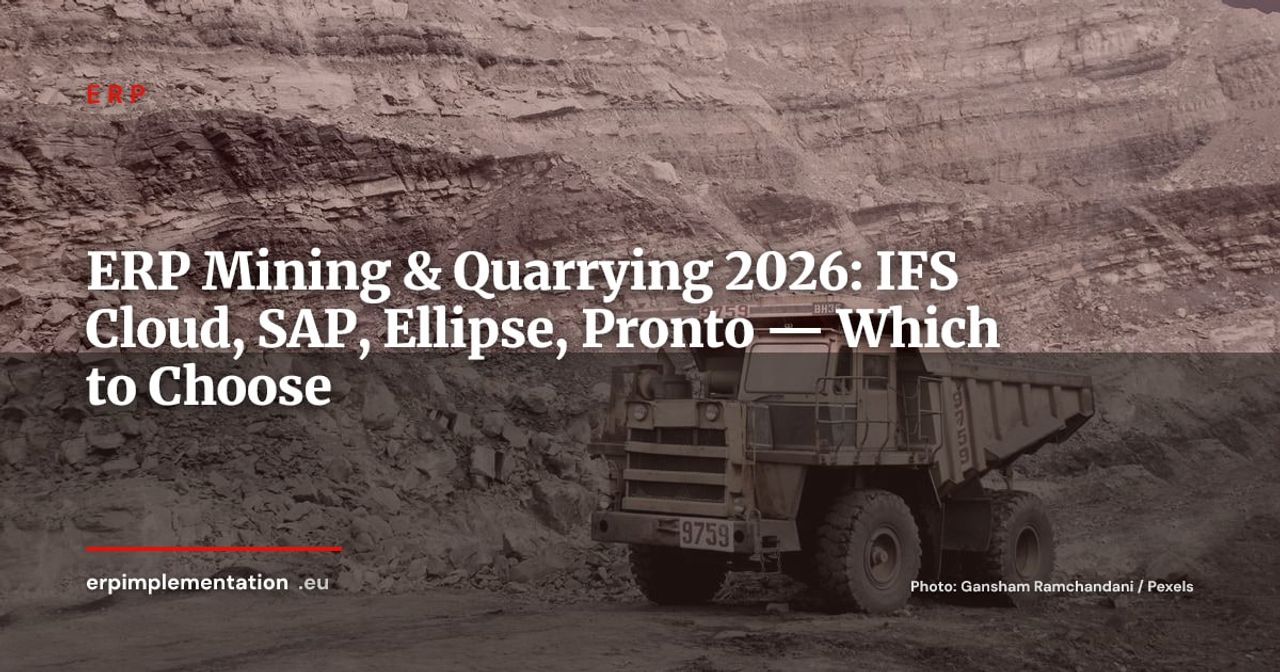
Mining and quarrying operate in a world fundamentally different from any other industrial sector. An aggregate quarry in the Canadian Shield, a cobalt producer in the DRC, and a publicly listed lithium mining group in Argentina all share one thing in common: their generic ERP systems simply do not cover their core business. Grade-based production management, cost-per-tonne calculations, heavy equipment maintenance, and a growing body of regulatory obligations — Battery Passport, CBAM, mining waste directives — demand functionality that SAP Finance or a mid-market generalist ERP cannot provide natively.
This comparison maps the available solutions, their real strengths, and the selection criteria that matter based on the type of operation, size, and geography.
Why Generic ERPs Fall Short in Mining
A conventional ERP thinks in SKUs, purchase orders, and invoices. The extractive industry thinks in tonnes extracted, ore grades, strip ratios, and engine hours. The gap is fundamental.
Cost per tonne: the central KPI. In a mine or quarry, the relevant question is never “what is my revenue?” but “what is my extraction cost per tonne of payable ore?” An ERP that cannot compute this figure in real time — integrating machine hours, explosive consumption, haul truck fuel, and direct labour — is operationally useless. Mine managers steer by this KPI on a daily basis, not by monthly management accounts.
The strip ratio: a planning constraint generic ERPs ignore. To produce one tonne of payable ore, you often have to move several tonnes of waste rock. This strip ratio varies by pit section, depth, and ore grade. The ERP must embed it in production planning to estimate volumes, costs, and margin by zone. No standard ERP comes close to handling this out of the box.
CMMS is not an optional add-on. In mining, maintenance typically accounts for 50–70% of operating costs. A single unplanned Cat 793 haul truck outage can cost tens of thousands of dollars per day in lost production. Hour-based maintenance scheduling (rather than calendar-based), critical spare part management in remote locations, and overhaul planning for drill rigs and crushers require a depth of CMMS functionality that a generic ERP’s maintenance module cannot reach.
Rising regulatory obligations. EU Regulation 2023/1542 mandates a digital Battery Passport from 18 February 2027 for EV batteries and industrial batteries above 2 kWh (EU Battery Regulation compliance guide). This passport requires upstream supply chain traceability from the mine itself — especially for cobalt, lithium, nickel, and graphite — with due diligence obligations that came into effect in August 2025. For producers of critical raw materials supplying European buyers, the ERP must capture these data points at the point of extraction.
7 Must-Have Features in a Mining ERP
1. Grade-Based Production Management
The ERP must track production by pit zone with site-specific parameters: ore grade, moisture content, granulometry for aggregate quarries, and metallurgical recovery rate for metal mines. Mine reconciliation — comparing the tonnage and grade estimated by the geological block model against actual production — is a critical process the ERP must automate to detect variances and adjust planning in near real time.
2. Integrated CMMS for Heavy Equipment
Haul trucks, blast rigs, crushers, hydraulic shovels: a mine’s asset fleet can represent hundreds of millions of dollars in capital. The ERP must manage preventive maintenance on engine-hour intervals, alert ground crews before critical thresholds are reached, track spare-part inventory with accurate lead times (often 4–12 weeks for imported components), and report maintenance cost per machine and per tonne extracted.
3. Concession and Permit Management
A mining concession carries an expiry date, delineated extraction zones, and end-of-life rehabilitation obligations. The ERP must track all of these: active zones, restricted areas, renewal dates, and volume entitlements by period. Integration with geographic information systems (GIS) enables visual monitoring of extraction progress against concession boundaries — a capability absent from generic platforms.
4. Health, Safety and Environment (HSE/QHSE)
Mines rank among the most regulated workplaces on earth. The EU Mining Waste Directive (2006/21/EC) imposes waste management plans and tonnage traceability for tailings and settling ponds. National mining inspectorates enforce detailed incident-reporting, PPE tracking, and consumption records for blasting materials (explosives and detonators). The ERP must produce these regulatory reports natively.
5. Remote Supply Chain and Critical Spares
In an isolated mine — Sub-Saharan Africa, Latin America, the Canadian far north — a missing spare part can shut down a site for weeks. The ERP must manage differentiated safety-stock levels by equipment criticality, anticipate customs lead times for imported components, and optimise consolidated orders to reduce emergency air-freight costs.
6. Cost-per-Tonne Reporting and Profitability Analysis
A mine director’s dashboard permanently tracks direct cost (explosives, fuel, blasting labour) and total cost (overhead, maintenance, corporate allocation) per tonne extracted. Comparing these figures across zones of the same orebody, or across multiple mines in a group, identifies which zones should be abandoned, mechanised further, or fast-tracked for development. An ERP without zone-level and cost-element cost accounting is blind at the operational level.
7. ESG Reporting and Critical Raw Material Traceability
Beyond the Battery Passport, the Carbon Border Adjustment Mechanism (CBAM) is progressively applying to imports of certain materials into the EU. Listed mining groups must publish ESG reports aligned to the CSRD (applicable to large undertakings since 2024). The ERP must feed these reports with reliable data on Scope 1 emissions (equipment fuel, explosives), volumes of mining waste, and water consumption.
ERP Comparison: Leading Solutions for Mining and Quarrying
IFS Cloud
IFS Cloud is the solution that most naturally combines ERP, CMMS (EAM) and project management in a single platform designed for asset-intensive industries. For mining, IFS stands out for its functional depth in asset management, predictive maintenance, and exploration and development project management (IFS Mining Solutions).
Mining strengths: Market-leading CMMS depth, native HSE integration, capital project management (shaft sinking, new drives), full financial visibility on cost per tonne. Gartner recognises IFS as a 2024 Customers’ Choice in Enterprise Asset Management Software.
Weaknesses: High initial investment (enterprise-tier solution), GIS integration and geological modelling require specialist partners. Smaller language support in some regions means that deployments in non-English-speaking markets will need certified bilingual implementation partners.
Best fit: Metal mines (gold, cobalt, copper, nickel), onshore oil and gas, operations with 200+ employees running a complex heavy-asset fleet.
SAP S/4HANA with Industry Cloud for Mining
SAP does not ship a native mining module in the S/4HANA core, but a certified partner ecosystem (NTT Data, Accenture, IBM) has built sector add-ons that cover grade management, mine reconciliation, and ESG reporting. SAP’s strength lies in financial coverage and analytics (SAP Analytics Cloud), which is invaluable for multi-mine groups that need rigorous group consolidation.
Mining strengths: Best-in-class financial and accounting backbone, native CSRD and ESG reporting (via SAP Sustainability Control Tower), integration with planning systems (SAP IBP), global network of implementation partners.
Weaknesses: Few native mining modules — core mine management (grade, reconciliation, concessions) relies on partner developments. Long implementation cycles (18–36 months for a large group), high total cost of ownership.
Best fit: Major international mining groups (Rio Tinto, Glencore, Anglo American) whose group ERP backbone is already SAP and who need to extend coverage to the mining perimeter.
Ellipse EAM (Hitachi Energy)
Ellipse EAM, now in the Hitachi Energy portfolio (originally from the ABB lineage), has over 30 years of deployment history in asset-intensive industries: mining, utilities, defence, and public infrastructure (Ellipse EAM, Hitachi Energy). Ellipse has been deployed in mines across Australia, South Africa, Latin America, and Asia-Pacific.
In 2026, Hitachi Energy is modernising Ellipse with Microsoft Dynamics 365, Microsoft Fabric, and Microsoft 365 Copilot integration to refresh the user experience and analytics capabilities.
Mining strengths: Exceptional CMMS with ISO 55000-aligned processes, spare-part stock management for remote sites, rugged mobile field interface, integrated asset/work/finance/HR management in a single database.
Weaknesses: Legacy interface historically dated (currently being redesigned), finance module less developed than SAP or Oracle, limited footprint in Europe outside the UK and Nordic regions, no SAP integration out of the box — groups on a SAP backbone will need to maintain two systems.
Best fit: Heavy-asset operations where CMMS is the central challenge, multi-site operations across Australasia, Anglophone Africa, and Latin America.
Pronto Xi
Pronto Xi, developed by Pronto Software (Australia), is the reference ERP in Australian mining and has a significant user base in North America. The solution combines finance, inventory, CMMS, business intelligence, and project management in a single database with no middleware to maintain (Pronto Software Mining). Hundreds of mining companies use Pronto Xi across Australia, Africa, North and South America.
Mining strengths: Pragmatic all-in-one approach, deep Australian mining culture embedded in the product (royalties, Australian concession management patterns), strong functionality-to-cost ratio, faster deployment than SAP or IFS.
Weaknesses: Very limited footprint in Europe, French-language support absent, OHADA chart of accounts not natively supported (requires adaptation for Francophone Africa), less well known among European IT leadership teams.
Best fit: Mining groups operating in Australia, Anglophone Africa, and Canada; mid-market companies seeking an integrated solution without the complexity of SAP.
Odoo with Third-Party Mining Modules
Odoo is not a native mining solution, but several integrators offer “extraction” verticals on the Odoo 17 foundation — primarily targeting smaller aggregate quarries. The approach combines Odoo Finance, Purchasing, Inventory, and Maintenance modules with custom development for grade-based production management and cost-per-tonne reporting.
Strengths: Substantially lower acquisition cost, flexibility, suitable for operations under 100 employees, rapid deployment (3–6 months).
Weaknesses: CMMS insufficient for a complex heavy-equipment fleet, HSE must be built from scratch, Battery Passport and ESG reporting not natively covered, technical debt risk if custom developments are not properly maintained.
Best fit: Small regional aggregate quarries (limestone, sand and gravel) with 20–80 employees whose CMMS requirements remain straightforward.
Comparison Matrix
| Criterion | IFS Cloud | SAP S/4HANA | Ellipse EAM | Pronto Xi | Odoo + modules |
|---|---|---|---|---|---|
| Heavy Equipment CMMS | Excellent | Good (via partners) | Excellent | Good | Insufficient |
| Mining Production Management | Good | Average (add-ons) | Average | Good | Weak |
| ESG / Battery Passport Reporting | Good | Excellent (native) | Average | Weak | Weak |
| Finance and Group Consolidation | Good | Excellent | Average | Good | Average |
| English-language Support | Good | Excellent | Good | Excellent | Good |
| Deployment Cost | High | Very High | Medium-High | Medium | Low |
| Implementation Timeline | 12–18 months | 18–36 months | 12–24 months | 6–12 months | 3–6 months |
| Target Size | 200+ employees | Large groups | 150+ employees | 50–500 employees | < 100 employees |
Use Cases by Operation Type
Aggregate quarries. Small to medium aggregate producers — limestone, sand and gravel — with 50–150 employees do not need IFS Cloud or SAP. A well-configured Odoo instance with production modules, or a specialist aggregates platform, typically covers the essentials: stock management by aggregate grade, crushing-plant scheduling, and construction-sector billing. The CMMS requirement stays manageable if the equipment fleet is limited to fewer than 10 machines.
African metal mine exporting critical raw materials. A cobalt, gold, or copper producer with 500 employees and Battery Passport traceability obligations operates in an entirely different register. IFS Cloud or SAP S/4HANA with mining extensions are the only credible options for covering grade management, heavy-asset CMMS, critical raw material traceability, and ESG reporting for European buyers under the CSRD.
International multi-mine group. As soon as a group operates five or more sites in different countries, group financial consolidation, intercompany management, and group reporting become the priority challenges. SAP remains the de facto backbone in large natural-resources groups such as Rio Tinto, Glencore, and BHP. For upper mid-market groups, IFS Cloud offers a better coverage-to-complexity ratio.
5 Questions to Select Your Mining ERP
1. How complex is your CMMS requirement? If your fleet includes more than 50 heavy assets maintained on multi-thousand engine-hour schedules, you need IFS Cloud or Ellipse EAM. Below that threshold, Pronto Xi or a capable generalist may suffice.
2. Do you have critical raw material traceability obligations? If you extract cobalt, lithium, nickel, or graphite destined for European buyers, the Battery Passport applies from 2027. Your customers will request traceability data. Only IFS Cloud and SAP S/4HANA cover this need natively or through certified extensions.
3. How many sites do you operate, across how many countries? A single site can manage with a simpler ERP. Five sites across three jurisdictions demand group consolidation, multi-currency management, and a configurable chart of accounts per entity. That is the domain of SAP or IFS.
4. Is SAP already your group backbone? If headquarters mandates SAP for finance and reporting, it is generally more coherent to deploy SAP S/4HANA at mine sites with sector add-ons than to introduce IFS Cloud in parallel and maintain an interface between the two systems.
5. What is your site connectivity? Some mines operate in areas with no reliable internet connection. The ERP must support a degraded offline mode and sync as soon as connectivity is restored. Ellipse EAM and Pronto Xi have decades of experience with this constraint. A pure-SaaS ERP without an offline mode is a non-starter for remote operations.
What to Watch Through 2030
Two dynamics will reshape mining ERP requirements before the end of the decade.
Critical raw material traceability will expand. The Battery Passport is the first wave — additional regulations (Critical Raw Materials Act, Corporate Sustainability Due Diligence Directive) will impose unprecedented documentation requirements on extractors. ERP systems that lack supply chain traceability modules will struggle to keep pace.
AI-driven predictive maintenance is gaining ground rapidly on large mining equipment. Both IFS and Hitachi (Ellipse) are investing in anomaly detection modules powered by IoT sensor data from heavy assets. For an operator where CMMS accounts for 60% of operating costs, reducing unplanned stoppages by 15% translates into millions of dollars in annual savings.
For further reading, see our article on CMMS and industrial maintenance in ERP, our comparison of ERP for energy and utilities: SAP IS-U, Oracle Utilities, IFS Cloud, and our guide to CSRD reporting in ERP.