
Before talking about management information systems, what is an information system?
An information system is a set of elements that allow collecting, storing, processing, and distributing data related to an entity’s activity.
What is a management information system?
Sharing the same attributes as a general information system, a management information system enables managers to have an accurate picture of their company’s activity at a given date. Accounting is an example of a management information system. Thanks to it, the manager can have visibility into the state of their business at any given time.
What are the components of an information system?
The first element of an information system is people. Even without employees, the manager is the first element of the information system.
The second element is data. It needs to be materialized in writing, audio, images, or other formats suited to the company’s management needs. A dashboard, for example, can contain figures, charts, and any other representation of information useful for understanding the company’s activity.
The third element is the means of collection. In a marketing agency, a web form can be used to collect prospect data and feed the CRM.
The fourth element is the information storage medium. This can be hardware, for example a software database such as an ERP, a register where data is entered, or any other means of preserving information.
The fifth element concerns the means of processing. Procedures and management rules must be defined to specify the data transformations that will be necessary. For example, adding a “Facebook” tag to a lead record captured on this social network to ensure traceability of the prospect’s origin.
Finally, the sixth element is the means of distribution. For an invoice, for example, this could be a page in a web application or a paper document that provides information related to a commercial transaction.
The business model of a marketing agency
Marketing agencies have needs common to all businesses, such as accounting management, as well as specific requirements related to their industry. Let us look at all of these needs together.
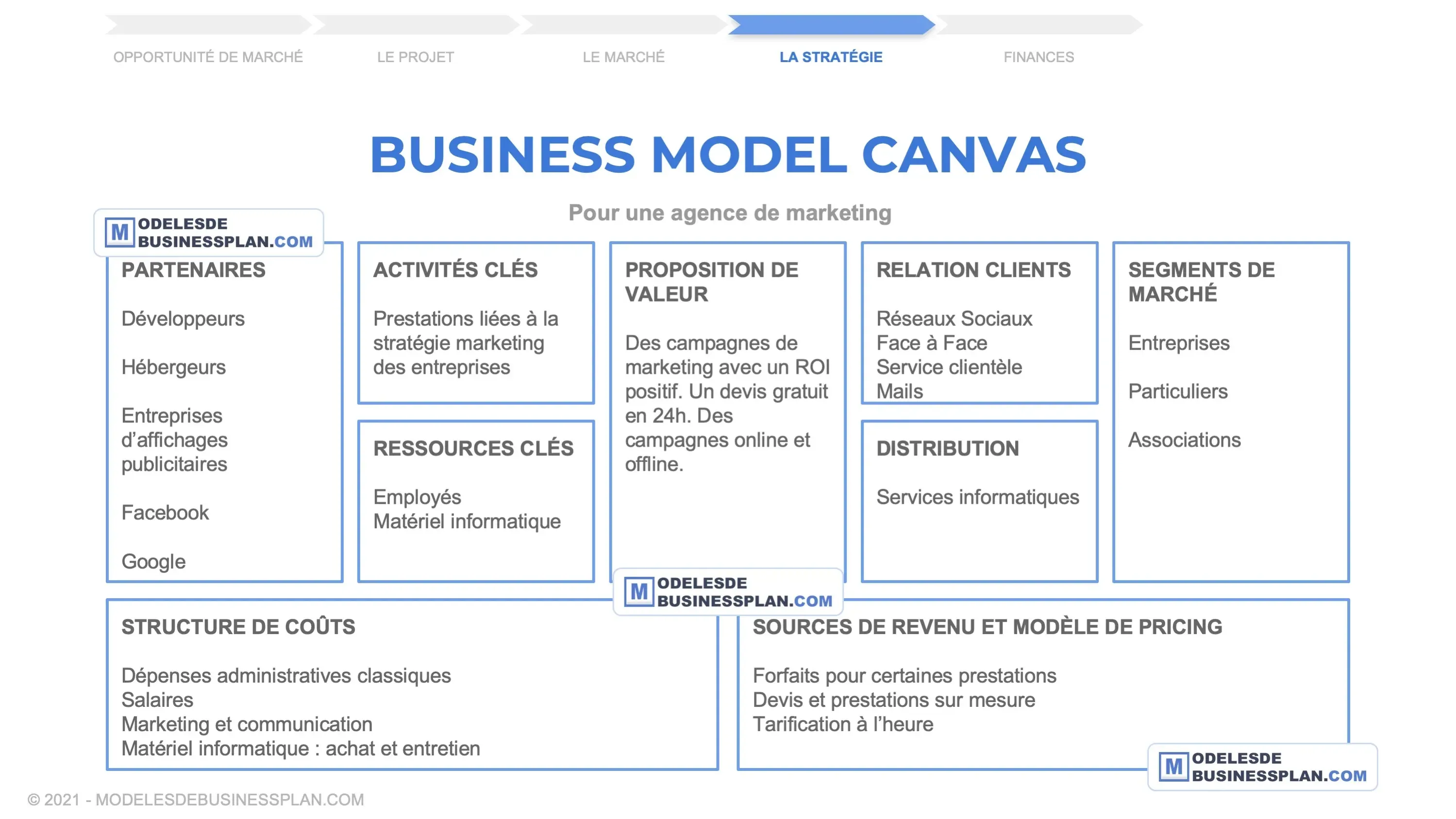 Example of a marketing agency business model according to https://modelesdebusinessplan.com/
Project-based operations
Agencies — and not only those in marketing — generally work in project mode, with resources allocated to achieve the objective set with the client.
The imperatives of project-based work
Project-based organization requires monitoring progress both toward achieving the objective and in the use of resources allocated to the project at its inception.
Achieving the final objective involves completing a list of actions or tasks related to marketing activities. These tasks are known in advance but can be supplemented during the project. Completing these tasks means progressing toward the objective.
In parallel, this progress consumes resources. And this expenditure must be tracked to ensure that the remaining resources are sufficient for the work still needed to achieve the objective.
These imperatives influence the entire lifecycle of the agency’s service beneficiaries.
From prospect to signed client
Marketing agencies can acquire prospects in various ways:
- Online through organic or paid channels;
- Through business networks;
- Through personal networks (executives, employees);
- By participating in events;
- Through advertising displays;
- Through cold calling;
- Through prospecting emails;
- Through referrals from former clients.
Regardless of the methods used, agencies must be able to record:
- The date of the first contact with the prospect;
- The prospect’s contact details;
- The prospect’s level of interest in the agency’s services;
- The next step.
In this stage from prospecting to signing, the methods differ from one agency to another. And they can differ within the same agency from one project to another.
Some projects may be signed in a single meeting, while others will require two meetings (R1 and R2) or more. Others may be signed without a meeting, directly through online registration.
It is important to build an information system that can handle the specificities of the agency in question.
From signed client to satisfied client
Here the agency must ensure:
- Onboarding;
- Scoping;
- Delivery;
- Closure;
- Follow-up.
The delivery stage involves steps specific to each agency. It may include persona creation, logo design, or benchmarking.
The essential aspect in this phase of the beneficiary’s lifecycle is to maintain a high-quality client relationship. Issues related to project progress and resource consumption tracking become increasingly important.
In addition to the client lifecycle, the relationship with suppliers must also be monitored to ensure the availability of production resources.
Not to mention the relationship with the government, which is best not forgotten in order to continue operating with peace of mind.
We will return in more detail to all of these elements in the upcoming parts of this tutorial before presenting applicable information system models.
Want to learn more? Check out our other articles on ERP implementation where we cover these topics in detail.