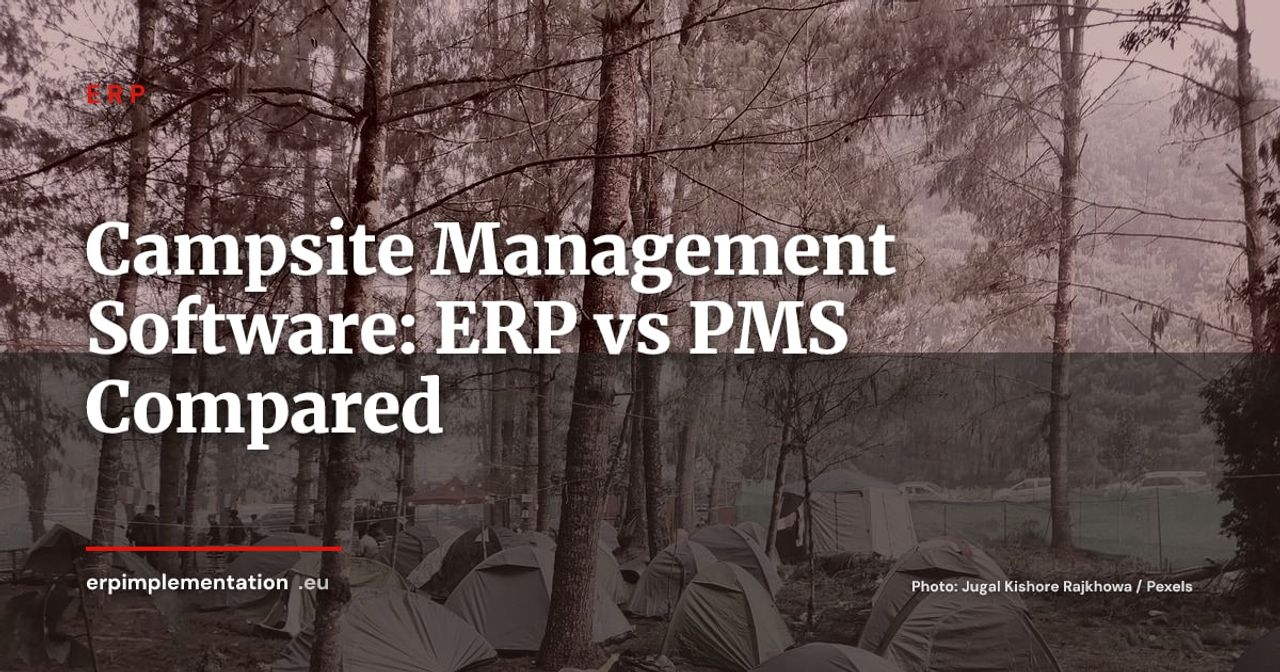
A campsite is not a hotel, a leisure park or a retail shop. It is all three at once, over a short season, with a team that doubles in June and shrinks to a handful of people in November. The software that handles bookings is rarely the one that keeps the books, and the till in the camp shop does not always talk to seasonal payroll. For an independent owner, that split is manageable. For a group of several sites, it becomes the main obstacle to seeing performance clearly.
This article compares four information system approaches for outdoor hospitality: a specialist booking tool used on its own, an adapted hotel PMS, a general-purpose ERP with connectors, and an integrated vertical suite. The goal is to help you choose based on your size and your ambition for management reporting, not to crown a winning vendor. No vendor is recommended here: before any shortlist, check the advertised features on each vendor’s official website and in a demo using your own real scenarios.
What Sets a Campsite Apart from a Hotel
Pitches and rental accommodation: two business models on one site
A campsite sells two products that follow different rules. The touring pitch (tent, caravan, motorhome) is rented by the night with fine-grained allocation criteria: surface area, electric hook-up, shade, distance to the sanitary blocks, maximum vehicle length. Rental accommodation (mobile homes, chalets, safari tents) is closer to a holiday let: stays counted in weeks, fixed arrival days, check-in and check-out inspections, end-of-stay cleaning, and sometimes mobile-home owners who let their unit through the campsite.
A standard hotel PMS thinks in interchangeable “rooms” by category. A campsite thinks in unique pitches, often named or numbered, that loyal guests ask for year after year. This difference in data model is the first source of mismatch.
Seasonality distorts every process
Seasonality is not just a peak in occupancy. It shapes:
- Cash flow: booking deposits arrive months before the season, while payroll and energy costs hit during it. Accounting must handle deferred income cleanly, without workarounds.
- Human resources: seasonal contracts, opening and closing of the season, rehiring the same people year after year, overtime in peak season.
- Pricing: rate grids by period, sliding rates by length of stay, last-minute offers in the shoulder season.
- Maintenance: the off-season is used to refurbish accommodation, water and electricity networks, and swimming pools.
Ancillary services that drive the margin on some sites
Grocery shop, snack bar, restaurant, bar, bike hire, entertainment, laundry, EV charging points, local products shop: these activities generate their own cash flows, stock, purchasing and margins. A campsite that manages them in a separate spreadsheet loses sight of real profitability per guest and per stay. This is where the question “booking software or ERP?” becomes concrete: where does the scope of the first end, and where does the second begin?
Local obligations
The tourist tax (visitor levy) is collected by the operator on behalf of the local authority. Rates and filing procedures depend on the municipality or region, which complicates life for a group present in several territories. The software must set rates per site, handle exemptions and produce the filing statement expected. For the applicable rules, refer to your local authority’s official source or the relevant government portal. On top of that come guest registration requirements for foreign visitors in some countries, safety and guest-reception obligations, and VAT by activity (accommodation, catering, retail sales), which does not apply the same rate everywhere.
The 4 Information System Approaches
Approach 1: specialist campsite booking software, used on its own
Scope. Pitch and rental planning, pricing by period, online booking engine, stay invoicing, often a simple point-of-sale module and a link to the tourist tax.
Strengths. Fast to deploy, native industry vocabulary (pitch, mobile home, arrival day), moderate entry cost, easy adoption by a seasonal team with little training. For an independent campsite, it is often the right starting point.
Limits. Accounting, purchasing, stock and payroll stay outside. Cost accounting by activity is limited to what the tool exports. Multi-site consolidation is not its core business: each campsite tends to become an island, with its own exports to the accountant. By the second or third site, re-keying appears.
Cost of ownership (qualitative). Low at the start, then rising with the number of sites: the hidden cost sits in the manual reconciliation work and in the reliability of the exports.
Approach 2: a hotel PMS adapted to outdoor hospitality
Scope. A property management system (reservations, front office, invoicing, channel manager, POS integration) configured to represent pitches and accommodation as “room types”.
Strengths. A mature channel manager and connectors to online travel agencies, revenue management features, a wide integration ecosystem. Useful for a site that also sells hotel rooms, holiday apartments or cottages and wants a single front-office tool.
Limits. The “room” model fits poorly with named pitches, vehicles, criteria-based allocation and owner-occupied mobile homes. Adaptations rely on workarounds (fictitious categories, free-text fields) that are fragile in daily use. The ancillary till (shop, snack bar) generally needs another tool. Again, accounting, payroll and consolidation sit elsewhere.
Cost of ownership (qualitative). Medium to high: licence and integrations of a hotel PMS, plus the cost of the diverted configuration and of training teams who do not speak hotel vocabulary. Relevant mainly if the group is mixed (hotels and campsites).
Approach 3: a general-purpose ERP with connectors
Scope. An ERP covers general and cost accounting, purchasing, stock, payroll (or a link to a payroll tool) and consolidation. The booking software (approach 1) or the PMS (approach 2) remains the operational front-office system, connected to the ERP by interfaces that feed sales, receipts, tourist tax and deposits.
Strengths. A single ledger, analytical dimensions by site and by activity (accommodation, catering, shop, entertainment), native consolidation for groups, centralised purchasing and budget control. This is the approach that makes one site’s profitability readable against another’s. For the consolidation framework, see our guide on ERP for multi-site networks.
Limits. You have to manage the integration: any version change in the booking software or the till can break a flow. The ERP does not replace pitch planning. Governance of master data (product codes, tax codes, analytical plan) requires a real project team, which a small group often lacks.
Cost of ownership (qualitative). Higher at the start (licences, integrator, connectors), more stable afterwards, with a net gain as the number of sites grows. The line to watch is interface maintenance, not the licence.
Approach 4: an integrated vertical suite
Scope. A vendor offers a platform that brings together booking, point of sale, shop stock, sometimes accounting and payroll, in a single database, with features designed for outdoor hospitality.
Strengths. No interface to maintain between components, one customer database, one support contact. Industry functions are native: pitch allocation, mobile-home owners, tourist tax. For a regional group that wants a single tool, it is appealing.
Limits. The depth of financial functions (detailed cost analysis, multi-company consolidation, multi-currency, internal control) varies and must be checked in a demo. The risk of dependency on a single vendor is real: exit cost, pace of product evolution, proprietary data model. Some vertical suites are strong on front office and lighter on group accounting.
Cost of ownership (qualitative). Predictable on the software side, with a risk of high exit costs over time. Ask about data reversibility (export formats, lead time, cost) before signing.
Comparison Table of the 4 Approaches
The ratings below are qualitative and generic: they describe what each approach does by design, not what a specific vendor does. Verify every line in a demo.
| Function | 1. Specialist booking tool alone | 2. Adapted hotel PMS | 3. ERP + connectors | 4. Vertical suite |
|---|---|---|---|---|
| Pitch and rental booking | Native, strong | Worked around (room types) | Via the front-office software | Native, strong |
| Channel manager | Often present, variable | Mature | Via the front office | Varies by vendor |
| Till and shop | Basic or external | Usually external | Via a connected till | Often integrated |
| Tourist tax | Native, per site | To be configured | Posted and accounted for | Native |
| Cost accounting by site and activity | Limited (exports) | Limited (exports) | Strong | Varies, to be checked |
| Seasonal payroll | Out of scope | Out of scope | Module or linked tool | Varies, to be checked |
| Multi-site consolidation | Weak | Weak to medium | Strong | Varies, to be checked |
| Integration effort | Low | Medium | High | Low |
| Main risk | Data silos | Model mismatch | Interface maintenance | Vendor dependency |
Quick read: approaches 1 and 4 win on industry fit, approach 3 wins on finance, and approach 2 wins only if hotels are part of the group.
Recommendation by Profile
Independent campsite (one site)
Recommendation: approach 1, with a clean export to the accountant. An ERP would be oversized, and the team’s time is better spent on guest welcome. Watch three points: the quality of the online booking engine integration, tourist tax handling, and the ability to export ledger entries in a format your accountant can read without re-keying.
Regional group (2 to 10 sites)
Recommendation: approach 4 if the vendor demonstrates sufficient group accounting, otherwise a lightweight approach 3. The tipping point is consolidation: if you still build the group report in a spreadsheet every month, you are already at the point where the gap costs you. Test an end-to-end scenario in the demo: one booking, one deposit, one till receipt at the shop, one analytical entry per site, and the tourist tax for two different municipalities.
Operator with 10 sites or more
Recommendation: approach 3, an ERP with a standardised front office. At this size, financial visibility and data governance outweigh the ease of use of a single tool. Standardise the booking software across all sites (or a small number of products), define the common analytical plan and treat the interfaces as an asset to maintain, with a named owner. A hotel PMS (approach 2) only becomes relevant if the group also operates hotels.
Our firm position: do not buy an ERP to manage bookings, and do not buy booking software hoping it will carry group accounting. Choose the front office for industry fit and the back office for financial rigour. Between the two, what determines success is the quality of the data flow, not the names of the software.
Critical Integrations and Personal Data Risks
The flows to secure first
Whatever the approach, five flows concentrate the incidents:
- Booking to accounting: deposits, balances, refunds, deferred income.
- Till to accounting and stock: receipts by payment method, VAT by activity, shop consumption.
- Tourist tax: calculation per stay, per municipality, periodic filing.
- Channel manager to planning: availability and rates, to avoid double bookings.
- Planning to payroll: seasonal staff hours, under the rules of your applicable labour agreement.
For hospitality in general, our hotel and restaurant ERP comparison covers the PMS and channel manager logic in detail.
GDPR: a campsite holds more sensitive data than it seems
A campsite collects the identity of adults and children, licence plates, contact details, sometimes health information (accessibility needs, food allergies for the restaurant), payment methods and, in some countries, identity documents for guest registration. Four risks keep coming back:
- Proliferation of copies: the same guest records live in the booking software, the channel manager, the till, the email tool and the ERP. Map them in your record of processing activities.
- Retention periods: a guest who has come back seven summers in a row does not justify keeping, without limit, the data of a guest who never returned. Configure purge and anonymisation.
- Processors: every vendor and every payment provider is a data processor. Check the contract, the data hosting and its location.
- Seasonal teams: role-based access rights, removal of access at the end of the season, short and repeated training.
For a deeper look at the ERP-side obligations, read our guide on ERP and GDPR compliance.
Selection Checklist: 10 Questions
- Does the software natively handle allocation of a named pitch and rental accommodation, without workarounds?
- Can you price by period, by length of stay and by fixed arrival day, with shoulder-season offers?
- Is the tourist tax configurable by site and by municipality, with the expected filing statement?
- What is the scope of the channel manager: which channels, what synchronisation, how are availability conflicts handled?
- Is the shop and snack bar till integrated, or linked through a connector whose maintenance the vendor guarantees?
- Can you get a P&L per site and per activity without reprocessing in a spreadsheet?
- Are seasonal payroll and staff planning covered, or linked to a tool that handles your labour agreement?
- What is the reversibility: export formats, lead time, cost if you change vendor?
- Where is the data hosted, who are the processors, and what does the contract provide for GDPR?
- Has the end-to-end scenario (booking, deposit, till receipt, ledger entry, tourist tax) been demonstrated on your own data before signing?
If three or more answers are vague, do not sign: run a one-season pilot on a single site, with written success criteria.
To structure your comparison, download our ERP selection grid: 30 criteria scored out of 100 to benchmark three solutions side by side, whether you end up with a vertical suite or an ERP architecture with connectors.