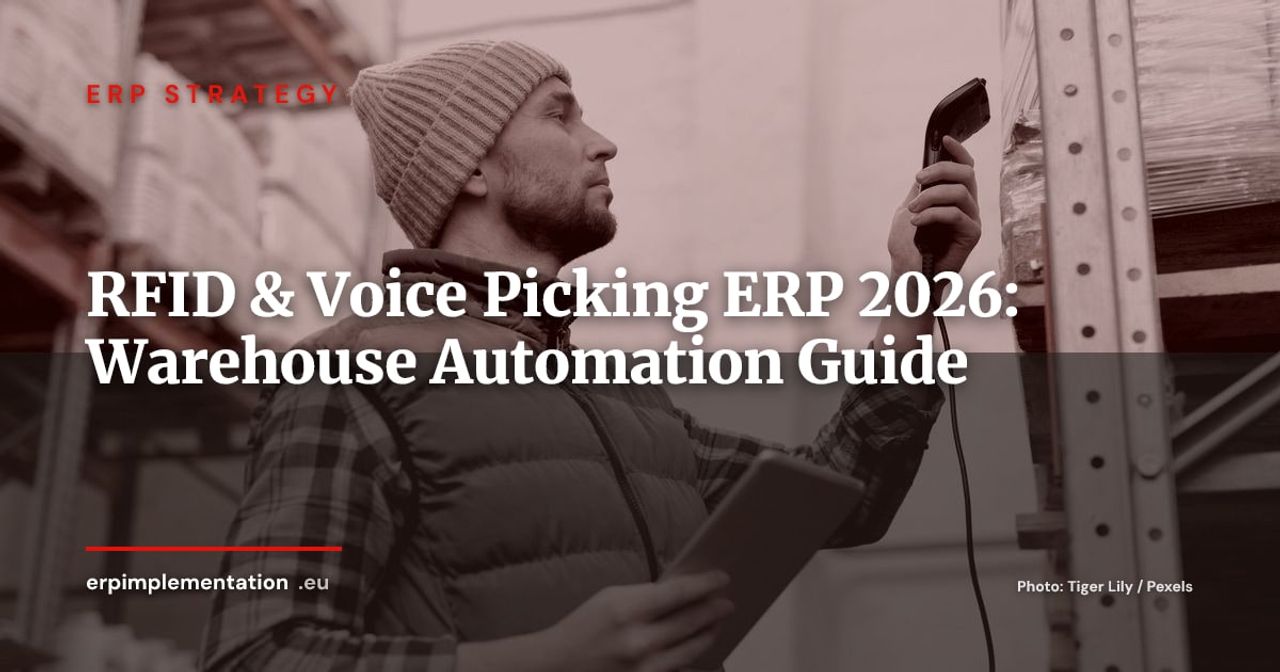
Your logistics team spends hours each month on manual inventory counts, picking errors are driving customer disputes, and you know the next step is automation — without necessarily replacing your ERP. Good news: in the vast majority of cases, modernising your warehouse in 2026 does not require a three-year greenfield project. Passive RFID, voice picking, and 2D mobile terminals integrate with most ERP and WMS platforms via standardised connectors.
This guide covers the three main warehouse automation technologies (2D scan, UHF RFID, voice picking), their integration architecture with the ERP, documented ROI, and a method for choosing the right level based on your activity volume.
The Connected Warehouse Trio: RFID, Voice Picking, and 2D Scan
1D Barcode vs 2D Scan vs RFID: When Each Technology Is Justified
These three technologies are not in direct competition. They address different use cases and are often combined on the same site.
1D barcodes (EAN-13, Code 128) are the baseline technology. Cheap to print and readable by any scanner, they remain relevant for small warehouses processing fewer than 200 picking lines per day. The limitation: the reader must be aligned with the barcode precisely, which slows operations and prevents reading multiple items simultaneously.
2D scan (QR code, DataMatrix, GS1-128) stores more information: batch number, expiry date, serial number, logistics unit. With a Zebra TC5x or Honeywell CK65 terminal, an operator reads a DataMatrix in under a second from any angle. For food and pharmaceutical warehouses subject to batch traceability requirements, 2D scan is the minimum standard.
Passive UHF RFID (860–960 MHz, 865–868 MHz sub-band in Europe per ETSI EN 302 208) changes the paradigm entirely: no line of sight required. A portal or fixed reader can simultaneously identify more than 100 tags at distances up to 12 metres (fulfil.io, 2025). A forklift passing through a dock RFID portal has its entire contents recognised in under two seconds. In practice, in warehouse environments with metal pallets and liquids (which absorb radio waves), stable operational range sits between 3 and 6 metres.
| Technology | Range | Simultaneous reads | Unit cost | Ideal use case |
|---|---|---|---|---|
| 1D barcode | Contact | No | < £0.01 | Small warehouses, FMCG |
| 2D scan | Contact | No | £0.02–0.05 | Batch/serial traceability, expiry |
| Passive UHF RFID | 3–12 m | Yes (100+ tags) | £0.07–0.15 | Mass inventory, high-value items, real-time traceability |
Voice Picking vs Screen vs Paper: Measured Productivity Gains
Voice picking directs operators via audio instructions through a headset, freeing both hands and eyes. The operator confirms actions by voice commands (“taken”, bin number, quantity). Result: zero screen consultation, zero paper, operator fully focused on picking.
Documented gains consistently point to a 15–25% productivity improvement over screen or paper-based methods, with peaks of 35% in environments where operators wear gloves (cold stores, clean rooms). On accuracy, voice systems achieve 99.9% rates, compared to 95–97% with paper or screen methods (NetSuite, Voice Picking Guide). Error rate reduction is measured at 35–80% depending on context (Zetes, Voice Picking Solutions).
The advantage in cold storage is structural: at -22°C, operating a touchscreen terminal with thick gloves is virtually impossible. Voice picking maintains productivity without any special adaptations.
How Passive UHF RFID Works
Passive UHF RFID has no battery. The tag borrows energy from the reader’s electromagnetic field to respond with its unique identifier (EPC, Electronic Product Code). This backscatter mechanism enables tags at £0.07–0.15 each in standard volumes (fulfil.io, 2025), making ROI accessible once the unit value of a product exceeds £5–10.
Passive UHF tags come in formats suited to different substrates: flexible inlays for textiles, on-metal tags for mechanical parts, and liquid-compensated tags designed to offset absorption. Choosing the right tag for the substrate determines 80% of read quality.
How the ERP Orchestrates Warehouse Operations
ERP-Native WMS vs Best-of-Breed WMS: The Right Level for Your Activity
The question is not “which software is most powerful” but “what level of sophistication does my activity volume actually justify.” A best-of-breed WMS with 400 slotting algorithm parameters makes sense for an e-commerce warehouse processing 8,000 picking lines per day. It is oversized and costly to configure for a regional distributor with 800 lines.
ERP-native WMS (SAP EWM, Dynamics 365 SCM, Infor WMS, Sage X3 Logistics, Epicor Kinetic): batch/serial traceability, FEFO (First Expired First Out), location management, RFID support, and mobile terminals. Covers 80% of the needs of a B2B distribution or manufacturing warehouse. The decisive advantage is the absence of a critical interface between WMS and ERP: stock is real-time within the same system of record.
Best-of-breed WMS (Mecalux Easy WMS, Generix WMS, Hardis Group Reflex WMS, Access Group WMS): advanced pick-route optimisation, dynamic slotting, multi-site warehouse management with cross-site consolidation. Relevant when the ERP-native WMS hits operational limits. The ERP–WMS integration cost (interface, stock synchronisation, EDI) typically represents 15–30% of total project budget.
For a detailed framework on making this decision, see our guide ERP-native WMS vs Best-of-Breed vs 3PL.
Warehouse Flows in the ERP: From Receiving to Dispatch
An ERP with a WMS module covers seven main flows:
- Receiving: parcel scan or RFID dock portal, quality check, putaway to target location
- Putaway: automated rules by product family, temperature constraints, ABC rotation
- Pick-face replenishment: automatic alert when picking location drops below threshold
- Picking: pick order sent to terminal or voice headset, route optimisation
- Packing: weighing, parcel labelling, consumer unit management
- Dispatch: scan at outbound portal, EDI ASN (Advance Ship Notice) generation to customer
- Cycle counting: planned partial count by zone, automatic reconciliation in ERP
The ERP as System of Record: Real-Time Stock and FEFO
The benefit of a direct RFID–ERP or terminal–ERP connection is the elimination of synchronisation lag. When an operator picks a parcel with a Wi-Fi-connected terminal, stock decreases in the ERP instantly. This allows the sales team to sell in real time without over-promising, and procurement to trigger replenishment orders without waiting for end-of-day close.
For food and pharmaceutical sectors, FEFO (First Expired First Out) is a legal requirement. RFID combined with the ERP automates it: the picking algorithm selects the location of the batch with the nearest expiry date, and the voice operator is guided to that location without consulting any list.
Implementing RFID in Your ERP: Step-by-Step Guide
Required Equipment: Tags, Readers, and Portals
An RFID warehouse project is structured around four hardware components:
- Passive UHF tags: Impinj Monza R6 or NXP UCODE 8 inlays depending on substrate. Average cost £0.10 at volumes of 50,000 tags.
- Fixed readers: Impinj R700, Zebra FX9600, CAEN R1260I. These units drive 4–8 UHF antennas and handle up to 1,000 reads per second.
- Dock portals: aluminium frames with 2–4 integrated antennas, installed at loading and unloading dock entrances. Hardware cost: £3,000–8,000 per portal depending on width.
- RFID mobile terminals: Zebra MC3300R, Honeywell Dolphin CT45 XP-RFID. Enable manual inventory on specific racking without fixed portals.
ERP Integration Architecture: LLRP, GS1 EPC-IS, and Middleware
The standard communication protocol between RFID reader and middleware is LLRP (Low Level Reader Protocol, ISO/IEC 24971): it standardises interrogation commands across readers from different manufacturers via a common TCP/IP interface. On the data side, GS1 EPC-IS (Electronic Product Code Information Services) is the standard for sharing RFID events between trading partners.
The typical architecture deploys in three layers:
- RFID readers communicate via LLRP with dedicated middleware
- RFID middleware (Zebra Savanna, Impinj Octane SDK, or ERP-integrated module) filters spurious reads, deduplicates events, and aggregates by read session (one forklift pass = one consolidated event)
- ERP connector receives filtered events via REST API or message queue and updates stock movements
ERP platforms with native RFID support include SAP S/4HANA with EWM, Microsoft Dynamics 365 Supply Chain Management, and Infor WMS. For other ERP systems, the middleware acts as a bridge.
Common pitfall: procuring portals and tags before defining the middleware architecture and business rules (what counts as a “valid” read? How many reads on a tag confirm a movement?). This upstream configuration drives 60% of the system’s operational quality.
Concrete Use Cases: What RFID Makes Possible
Automated inventory: a forklift fitted with a side-mounted RFID antenna traversing the aisles continuously reads tags on racking pallets. In 2 hours, a warehouse of 5,000 SKUs is inventoried with 99.9% accuracy (warehousewhisper.com, RFID in Warehouse Management), versus 2 days of manual counting with dedicated teams. Walmart measured a stock accuracy improvement from 63% to 95% after RFID deployment (warehousewhisper.com).
Batch traceability and dock control: each incoming carton is tagged at receiving or pre-tagged by the supplier. The inbound dock portal reads the pallet contents in 2 seconds and automatically creates the receiving movement in the ERP with batch number, expiry date, and origin. Receiving dispute rates fall mechanically.
Shrinkage prevention: for high-value items (electronics, professional tooling), an RFID portal at the warehouse exit flags any departure not recorded in the ERP. Industrial equipment distributors have measured shrinkage reductions of 50–60% after installation (warehousewhisper.com).
Deploying Voice Picking: From Solution to ROI
Market Solutions: Vocollect, Zebra, Voxware, Lucas
Honeywell Vocollect is the established market reference with the A700 and Talkman series. The system is proprietary but has certified connectors for SAP EWM, Manhattan Associates, Oracle WMS Cloud, and Dynamics 365 SCM.
Zebra takes a different approach with Zebra Workforce Connect Voice, which turns a Zebra TC7x or MC9300 terminal into a voice picking solution without a dedicated headset. Lower entry cost, but ergonomics in noisy environments are less optimal.
Voxware and Lucas Systems target warehouses with more than 2,000 lines per day, offering more advanced orchestration platforms that combine voice picking, pick-to-light, and intelligent dispatch by zone and operator profile.
EPG LYDIA Voice (Zebra partner) stands out for its adaptive voice recognition engine: the system learns an operator’s voice in 10 minutes without a lengthy training phase, and can operate in multilingual mode across the same warehouse.
ERP/WMS Integration: Order Dispatch and Stock Confirmation
Voice picking–ERP integration operates in a three-step flow:
- The ERP creates the pick order (or the native WMS optimises it into a multi-line route) and transmits it to the voice middleware
- The voice middleware dispatches the order to the available operator based on zone and profile, sequencing picks in an optimised order (shortest path)
- The operator verbally confirms each pick (bin check digit, quantity), and the confirmation is relayed to the ERP in real time via API
Synchronisation latency is critical: if pick confirmations take 30 seconds to reach the ERP, a sales rep closing a deal simultaneously sees stale stock. Modern integrations operate at under 2 seconds of latency.
Voice Picking ROI: What Deployments Document
Productivity gain projections cited by vendors converge around +15–25% on average per Vocollect, with peaks of +35% in cold environments. Error rate reduction is more striking: voice systems push picking accuracy to 99.9% (NetSuite), versus 95–97% with paper methods. For a warehouse processing 3,000 lines per day, moving from 3% to 0.1% error means 87 disputes avoided every day.
A return on investment of 12–18 months is typical for volumes of 1,000–5,000 lines per day, accounting for headset costs (£350–700 per unit), middleware licence (£4,000–13,000/year depending on vendor), and ERP integration project (£8,000–25,000 depending on complexity).
Advanced Automation: AMRs and AGVs — When to Integrate Them with Your ERP
Autonomous mobile robots (AMRs) and automated guided vehicles (AGVs) represent the next step beyond voice picking and RFID. They do not replace these technologies but complement them for the largest volumes.
An AMR (such as Locus Robotics, Fetch Robotics, or 6 River Systems robots) navigates the warehouse autonomously to bring picking bins to stationary operators, who pick without walking. This “goods-to-person” model is relevant beyond 5,000 lines per day or in warehouses with large footprints (over 10,000 m²).
ERP–AMR integration runs through the WMS, which acts as orchestrator: it receives orders from the ERP, transmits them to the Robot Fleet Management System, and relays pick confirmations. SAP EWM, Manhattan Associates, and Blue Yonder WMS have native or certified connectors for the leading AMR platforms.
The break-even point for a full AMR deployment (20–50 robots plus infrastructure) typically lies above 5,000 lines per day. Below that threshold, voice picking alone or combined with RFID delivers a significantly faster ROI.
Checklist: Choosing Your Warehouse Automation Level
The question is not “which technology is best” but “which technology is justified by my volume and operational constraint.” Here is a simple four-level framework.
Level 1 — 2D Scan (fewer than 500 picking lines per day)
Investment: £5,000–15,000 (terminals + basic WMS software).
Appropriate if:
- Batch/serial traceability is required but volumes are low
- The existing ERP has an adequate native WMS module
- The IT team has no in-house RFID skills
Level 2 — Voice Picking (500–5,000 lines per day, or cold environment)
Investment: £18,000–70,000 depending on number of operators and voice vendor.
Appropriate if:
- Picking errors are generating recurring customer disputes
- Operators work in cold storage or with hand protection
- A 15–25% productivity gain is sufficient for an 18-month ROI
Level 3 — Passive UHF RFID (high unit value or regulatory requirement)
Investment: £25,000–130,000 depending on coverage area and number of portals.
Appropriate if:
- Item unit value exceeds £10 (tag cost justified)
- Frequent mass inventory is required (healthcare, luxury, aerospace)
- Real-time traceability is mandated by customers or regulation
Level 4 — AMRs / Conveyors (more than 5,000 lines per day)
Investment: £250,000 and above.
Appropriate if:
- The warehouse processes significant e-commerce or omnichannel volumes
- The footprint exceeds 10,000 m² with long picking routes
- Labour costs make the robotics ROI viable within 3–5 years
To go deeper on supply chain management strategies with your ERP, see our guide ERP and IIoT: Connecting Your Shop Floor in Real Time (OPC-UA, MQTT, Edge), which covers OPC-UA and MQTT protocols also applicable to advanced warehouse systems.