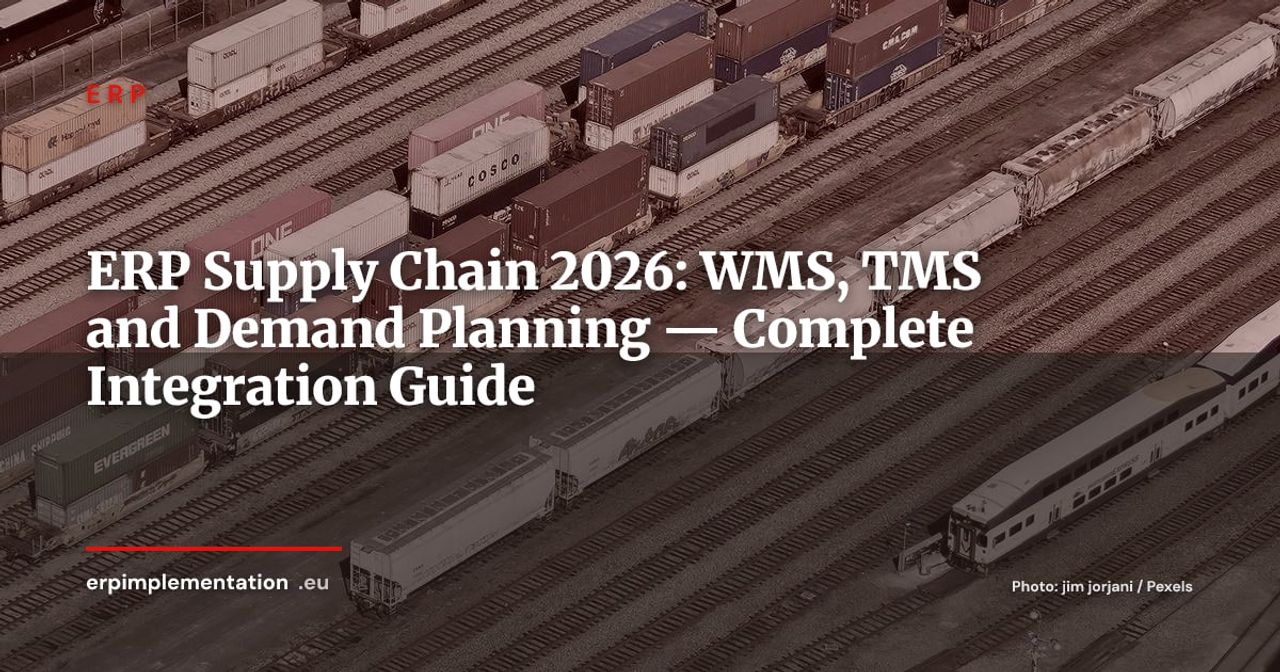
The supply chain is the nervous system of any business that produces, stores or distributes physical goods. Yet according to a Gartner study (2024), 67% of European SMEs still manage their logistics chain with Excel spreadsheets and disconnected tools. The result: recurring stockouts, excess transport costs, rough demand forecasts and near-zero visibility into flows.
Integrating supply chain modules into the ERP — WMS (Warehouse Management System), TMS (Transport Management System) and demand planning — transforms this reality. This expert guide breaks down these three pillars, compares leading European and global vendors, and illustrates the measurable ROI for SMEs and mid-market companies.
Why Supply Chain Is the Weakest Link in ERP-Free SMEs
The Hidden Cost of Silos
In a business without an integrated ERP, information travels by email, shared files and phone calls. Every department — procurement, production, warehouse, transport, sales — works with its own version of the truth.
The consequences are quantifiable:
- Stockouts: a distribution SME loses an average of 4 to 8% of annual revenue due to stockouts (source: IHL Group, 2023).
- Overstock: conversely, dormant inventory ties up between 20 and 30% of working capital in European manufacturing SMEs (ECB SME Survey, 2024).
- Transport costs: without route optimisation and load consolidation, freight costs run 15 to 25% higher than they should (Capgemini Research Institute, 2023).
- Wasted time: logistics teams spend up to 30% of their time manually re-entering data between systems (Aberdeen Group).
The Vicious Circle of Disconnection
Without ERP integration, every link in the chain operates blindly:
- Sales commits a product without knowing whether it is in stock.
- The warehouse picks the order without knowing the promised delivery date.
- The carrier receives an incomplete shipping document.
- Finance manually reconciles invoices with delivery notes.
This vicious circle generates cascading errors. An integrated ERP breaks these silos by providing a single source of real-time data — from the supplier purchase order all the way to the customer proof of delivery.
The 3 Essential Supply Chain Modules
WMS — Warehouse Management System
A WMS manages all warehouse operations: goods receipt, put-away, order picking, packing and dispatch.
Key features of an ERP-integrated WMS:
- Location management: warehouse mapping by zone, aisle, rack and bin. Every item has a precise physical address.
- Automated receiving: barcode scanning at receipt, integrated quality control, instant ERP stock update.
- Optimised picking: shortest-path algorithms (wave picking, zone picking, batch picking) that reduce picker travel by 25 to 40%.
- Cycle counting: automatically scheduled cyclical counts, variances surfaced in real time.
- Traceability: end-to-end lot/serial tracking — essential for food, pharma and chemical sectors.
Integrated vs. standalone? A WMS integrated with the ERP eliminates fragile interfaces. When a sales rep enters an order, the WMS automatically triggers stock reservation and pick release. No flat-file export, no overnight sync that fails.
TMS — Transport Management System
A TMS orchestrates outbound transport (customer deliveries) and inbound transport (supplier replenishment).
Key features of an ERP-integrated TMS:
- Route planning: multi-criteria optimisation (distance, time windows, vehicle capacity, cost) that cuts kilometres driven by 10 to 20%.
- Carrier selection: automatic rate comparison across carriers (negotiated rates, fuel surcharges, lead times), assignment to best cost/lead-time ratio.
- Real-time tracking: GPS tracking, delay alerts, electronic proof of delivery (ePOD).
- Claims management: automatic recording of damages, delays and refusals, with integrated claims workflow.
- Carbon footprint calculation: CO₂ estimate per shipment, in line with CSRD reporting requirements for European companies subject to sustainability disclosure.
The TMS–ERP link is strategic: the TMS pulls delivery orders directly from the ERP, calculates the optimal transport plan and feeds actual freight costs back into analytical accounting. No surprise carrier invoices at month-end.
Demand Planning — Forecasting Future Demand
Demand planning is the most transformative and least deployed module in SMEs. It uses sales history, seasonal trends, planned promotions and increasingly artificial intelligence to forecast future demand.
Key features:
- Statistical forecasting: exponential smoothing, ARIMA and regression models applied automatically by SKU, product family or customer.
- Machine learning: next-generation ERPs (SAP IBP, Infor Birst, Odoo with AI modules) embed ML algorithms that detect patterns invisible to classical models.
- Consensus planning: collaborative workflow where sales, marketing and supply chain teams validate and adjust forecasts together.
- Scenario simulation: “What happens if a key supplier is three weeks late?” — the engine simulates the impact on stock and deliveries.
- Safety stock management: dynamic calculation of the optimal safety stock level per SKU, based on demand variability and supplier lead time.
Why is this a game-changer for SMEs? A reliable forecast at 85–90% accuracy (versus 60–70% with Excel) simultaneously reduces stockouts AND overstock. According to McKinsey (2024), companies adopting AI-driven demand planning reduce their safety stock by 20 to 30% while improving service levels by 3 to 5 percentage points.
ERP Vendor Comparison for Supply Chain
SAP S/4HANA Supply Chain Management (Tier 1)
Target: large enterprises and upper mid-market (>500 users, >€50M revenue)
SAP offers the most comprehensive supply chain suite on the market with S/4HANA and its add-on modules:
- SAP EWM (Extended Warehouse Management): benchmark WMS for complex, multi-site warehouses, with automation (conveyors, AGVs, robots).
- SAP TM (Transportation Management): integrated TMS with advanced optimisation, e-CMR electronic consignment note support.
- SAP IBP (Integrated Business Planning): demand planning and S&OP with ML engine, real-time simulation.
| Strength | Limitation |
|---|---|
| Unmatched functional coverage | High cost (>€300K/year for full SCM) |
| Massive partner ecosystem | Deployment complexity (12–24 months) |
| Native integration with manufacturing | Over-engineered for SMEs <100 users |
Indicative budget: €200–500K/year licences + €300–800K SCM implementation.
Infor CloudSuite (Tier 2)
Target: industrial and distribution mid-market (100–500 users)
Infor stands out for its micro-verticals: CloudSuite Distribution, CloudSuite Industrial (formerly SyteLine), CloudSuite Food & Beverage. Each vertical natively embeds the sector’s supply chain processes.
- Infor WMS: cloud WMS leader (ranked “Leader” in Gartner Magic Quadrant WMS 2024), deployable standalone or integrated into CloudSuite.
- Infor Nexus: multi-enterprise supply chain network (supplier visibility, end-to-end traceability).
- Infor Demand Planning: ML forecasting with Infor Coleman AI.
| Strength | Limitation |
|---|---|
| Very deep sector verticals | Smaller partner network outside core markets |
| World-class WMS (standalone option) | User interface lags behind SAP Fiori |
| Reasonable mid-market pricing | Less name recognition than SAP or Oracle |
Indicative budget: €80–200K/year licences, €150–400K implementation.
Odoo Inventory + MRP + Purchase (Tier 3–4)
Target: SMEs (20–200 users, <€50M revenue)
Odoo takes a modular, progressive approach. There is no “heavy” WMS/TMS, but the modules cover 80% of SME needs:
- Odoo Inventory: multi-warehouse management, configurable logistics routes, barcodes, cycle counting.
- Odoo MRP: manufacturing orders, bills of materials, capacity planning.
- Odoo Purchase: automatic replenishment on reorder points, supplier RFQ management.
- Odoo Shipping: carrier integrations (DHL, UPS, FedEx, and national carriers).
| Strength | Limitation |
|---|---|
| Unbeatable price (€24–48/user/month) | Simplified WMS versus SAP EWM or Infor WMS |
| Modular: activate only what you need | Native demand planning is minimal |
| Open source (Community edition) | Warehouse performance above 50,000 SKUs needs validation |
| Belgium HQ, strong EU community | Rudimentary TMS (no route optimisation engine) |
Indicative budget: €15–60K/year licences, €30–120K implementation.
Manhattan Associates (Supply Chain Specialist)
Target: retailers, 3PLs and distribution mid-market to enterprise
Manhattan Associates is a US-listed, globally recognised supply chain specialist. Unlike generalist ERPs, Manhattan was built from the ground up for logistics:
- Manhattan Active WMS: cloud-native WMS with microservices architecture, ranked consistently in Gartner WMS Leadership quadrant.
- Manhattan Active TMS: transport planning, carrier procurement, real-time visibility, ePOD.
- Manhattan Active Supply Chain: unified platform linking demand, inventory and fulfilment planning.
| Strength | Limitation |
|---|---|
| Pure-play supply chain expertise | Requires a separate ERP for finance/accounting |
| Proven at massive scale (global retailers, 3PLs) | Premium price point, typically enterprise-tier |
| Rapid innovation cycle (weekly cloud releases) | Less relevant for light manufacturing or pure B2B |
Indicative budget: €100–300K/year, integration €200–500K.
Summary Comparison Table
| Criterion | SAP S/4HANA | Infor CloudSuite | Odoo | Manhattan Associates |
|---|---|---|---|---|
| WMS | ★★★★★ | ★★★★★ | ★★★☆☆ | ★★★★★ |
| TMS | ★★★★★ | ★★★★☆ | ★★☆☆☆ | ★★★★★ |
| Demand Planning | ★★★★★ | ★★★★☆ | ★★☆☆☆ | ★★★★☆ |
| SME-friendly | ★★☆☆☆ | ★★★☆☆ | ★★★★★ | ★★☆☆☆ |
| Price | €€€€€ | €€€☆☆ | €☆☆☆☆ | €€€€☆ |
| EU ecosystem | ★★★★★ | ★★★☆☆ | ★★★★★ | ★★★☆☆ |
Case Study: A Distribution SME Moving from Excel to a Supply Chain ERP
The Context
PartLink Distribution, a 90-employee industrial parts distributor operating across two warehouses. Annual revenue: €22M. 15,000 references, 450 orders per day.
Before the ERP: Organised Chaos
- Stock managed in Excel: three separate files per warehouse, updated manually each evening. Variance between physical and theoretical stock: 8%.
- Supplier orders by gut feel: the procurement manager relied on 15 years of experience rather than data. Stockout rate: 6% of order lines.
- Unoptimised transport: each warehouse chose its carrier independently. No inter-site load consolidation. Transport cost: 9.2% of revenue.
- No forecasting: seasonal peaks (back-to-school in September, vehicle service season in March) were managed reactively.
The ERP Project
PartLink selected Odoo Enterprise supplemented by a third-party WMS module for advanced voice-picking capabilities.
- Duration: 7 months (3 months configuration, 2 months data migration, 2 months training + cutover).
- Total budget: €98K (3-year licences: €44K, integration: €46K, training: €8K).
After 18 Months: The Results
| KPI | Before | After 18 months | Change |
|---|---|---|---|
| Stock variance | 8% | 1.2% | -85% |
| Stockout rate | 6% of lines | 1.8% | -70% |
| Transport cost / revenue | 9.2% | 7.1% | -23% |
| Order pick time | 12 min | 7 min | -42% |
| Average delivery lead time | 3.2 days | 1.8 days | -44% |
| Customer service level | 91% | 97.5% | +6.5 pts |
Calculated ROI: annual savings of €390K (transport reduction + overstock elimination + manual re-entry hours eliminated). Return on investment in 3 months after go-live.
Critical Success Factors
- Early involvement of the Head of Logistics during scoping — they knew every process flow inside out.
- Phased rollout: Warehouse 1 first (pilot site), Warehouse 2 six weeks later.
- Hands-on training: 2 days per team, using real products and real bin locations.
- Quick wins first: optimised picking was deployed first, delivering visible results from week one.
Checklist Before Choosing Your ERP Supply Chain Module
1. Map Your Current Flows
Before discussing ERP, document your actual processes:
- Where do your goods come from? How many suppliers?
- How many warehouses? What surface area? What storage types (pallet, piece-pick, bulk)?
- How many orders per day? What delivery lead time is promised?
- Which carriers do you use? Contracted or spot rates?
- How do you currently forecast demand?
2. Set Your Priorities
Not every module is needed from day one:
- Priority 1 — Stock and warehouse (WMS): if your stock variance exceeds 3% or your picking is too slow.
- Priority 2 — Replenishment: if stockouts are impacting sales or you over-order as a buffer.
- Priority 3 — Transport (TMS): if freight costs exceed 5% of revenue or you handle more than 50 shipments per day.
- Priority 4 — Demand planning: if you have at least 12 months of usable sales history and clear seasonality.
3. Verify Critical Integrations
- EDI/API with suppliers: can your main suppliers exchange data by EDI or API?
- Carriers: does the ERP integrate with your current carriers (labels, tracking)?
- E-commerce: if you sell online, ERP stock must sync in real time with your storefront.
- Customs: for import/export, check customs document management (SAD, certificates of origin).
4. Evaluate Total Cost of Ownership
Do not compare licences alone:
| Cost item | Typical share of total budget |
|---|---|
| Licences / subscription | 25–35% |
| Integration / configuration | 35–45% |
| Data migration | 10–15% |
| Training | 5–10% |
| Maintenance / evolution year 2+ | 15–20% of initial cost/year |
5. Demand a Proof of Concept (POC)
Before signing, request a POC on your own data:
- Import 1,000 real references into the candidate WMS.
- Simulate a full day of picking.
- Test forecast calculation on 12 months of real sales history.
- Check response times against your actual data volumes.
A vendor that refuses a POC is a warning signal.
The Future: Autonomous Supply Chain and Generative AI
The next wave of ERP supply chain evolution is already underway:
- AI control towers: real-time dashboards that detect anomalies (supplier delay, unexpected demand spike) and automatically suggest corrective actions.
- Digital twins: simulation of the entire supply chain to stress-test scenarios before applying them. SAP and Infor are investing heavily in this technology.
- Generative AI applied to S&OP: AI assistants that summarise forecast-versus-actual variances, generate supply chain performance reports and propose plan adjustments.
- Green supply chain: automatic carbon footprint calculation per product, route optimisation to minimise emissions, CSRD compliance built in.
For European SMEs, the good news is that these capabilities — once reserved for SAP’s largest clients — are progressively reaching mid-market and open-source ERPs. Odoo, Infor and even ERPNext are embedding AI building blocks that democratise intelligent supply chain for growing businesses.
Key Takeaways
An ERP-integrated supply chain is no longer a large-enterprise luxury. WMS, TMS and demand planning modules are now accessible to European SMEs from around €15K/year with Odoo, and deliver measurable gains within the first months: -70% stockouts, -23% transport costs, ROI within 6 months.
The formula for success: start with the module that solves your most acute pain point (usually the WMS), prove the ROI quickly, then progressively extend to TMS and demand planning. And above all, do not underestimate data migration and frontline team training — that is where projects succeed or fail.