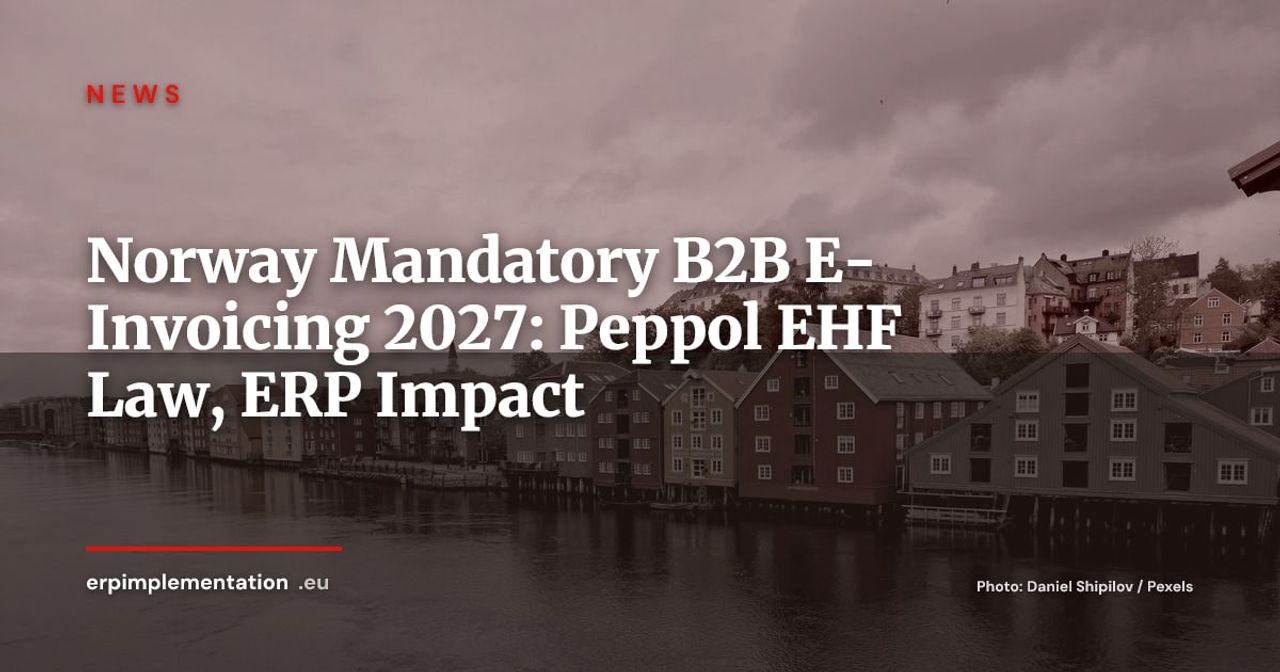
Norway’s Storting (parliament) passed on 20 June 2026, in a first reading, Act Prop. 44 L (2025–2026) amending the Accounting Act (bokføringsloven). From 1 January 2027, all Norwegian businesses with bookkeeping obligations will be required to issue B2B invoices in EHF Billing 3.0 — the Norwegian national profile of the Peppol network. A second phase in 2030 will mandate automated reception of e-invoices within accounting systems. Source: VATupdate, 20 June 2026.
Context: A Country Ahead of the Curve
Norway is not new to e-invoicing. Since 2012, public procurement (B2G) has required electronic invoicing via the ELMA registry — Norway’s national directory of Peppol recipients. The June 2026 vote extends the obligation to B2B transactions, consistent with the government’s broader digital transformation roadmap.
Act Prop. 44 L was introduced by the Ministry of Finance in early 2026. The Storting’s Finance Committee recommended its adoption unanimously on 7 May 2026 (Sovos), ahead of the first reading on 20 June. A second reading is expected before the end of summer 2026 to complete the legislative adoption.
The mandated format, EHF (Elektronisk Handelsformat) Billing 3.0, is Norway’s national implementation of the European standard EN 16931 and Peppol BIS Billing 3.0. It is interoperable with all other Peppol-connected countries: Belgium, the Netherlands, Denmark, Sweden, and beyond.
Two Deadlines, Two Levels of ERP Readiness
The law introduces two distinct phases with different implications for ERP systems.
Phase 1: issue in EHF from 1 January 2027. All businesses with a bookkeeping obligation (except those below NOK 50,000 in annual revenue, approximately EUR 4,300) must be able to generate and send B2B invoices in EHF 3.0 format via the Peppol network (Marosa VAT). The recipient must be registered in the ELMA registry. B2C sales and cash transactions are explicitly out of scope.
For ERP teams, this requires two concrete actions: configure the invoicing module to output EHF 3.0-compliant XML, and connect the system to a certified Peppol Access Point. Visma — dominant in Norway with its ERP portfolio (Visma Business, Visma.net ERP) — supports this format natively and provides an integrated Access Point. SAP S/4HANA and Microsoft Dynamics 365 require a third-party Peppol connector or add-on (Storecove, Pagero, Tradeshift, or equivalent).
Phase 2: automated reception from 1 January 2030. The second obligation targets the capacity to receive e-invoices automatically. Accounting systems will need to ingest and process inbound invoices without manual intervention (VATcalc). This is a more substantive ERP maturity requirement: it presupposes integration between the inbound Peppol flow and the accounts payable (AP) module or general ledger.
Businesses currently processing supplier invoices via scanned PDFs with OCR will need to migrate their AP workflow before 2030. This is not a configuration change — it is a project.
Three Things to Put on Your Radar Now
-
The Storting’s second reading: the 20 June 2026 vote is a first reading. The law must pass a second reading to be definitively adopted. Final adoption is expected before the end of summer 2026.
-
Secondary legislation: the exact modalities of the ELMA registry, exemption thresholds for micro-businesses, and transitional rules will be set out in implementing regulations published after the law is enacted.
-
ViDA alignment: Norway, as a member of the European Economic Area (EEA) but not the EU, closely monitors the ViDA (VAT in the Digital Age) regulation. If the EU mandates near-real-time digital reporting by 2030–2032, Norway will need to align its framework. Businesses investing today in clean Peppol infrastructure will be far better positioned to absorb these changes without a full system overhaul.
For broader context on the European e-invoicing wave, read our guide to Peppol and interoperable e-invoicing in Europe, our article on mandatory B2B e-invoicing in the Netherlands via Peppol, and our guide to Nordic and Dutch ERP vendors (Visma, Fortnox, Exact).