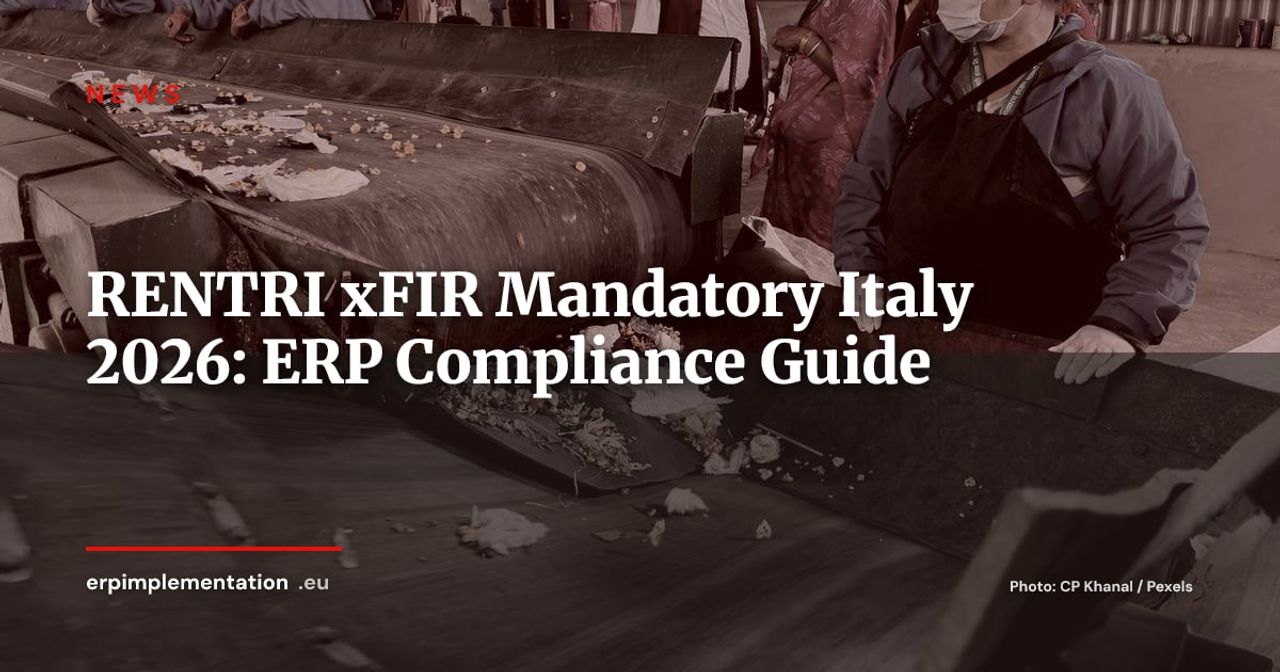
The transition period is over. From 16 September 2026, digital FIR — known as xFIR — is the only authorised format for operators registered with the RENTRI register in Italy. Non-compliant businesses face immediate administrative sanctions, and for hazardous waste, criminal exposure (TeamSystem Magazine, September 2026).
Background: RENTRI and Paper FIR
RENTRI (Registro Elettronico Nazionale per la Tracciabilità dei Rifiuti) is Italy’s national electronic register for waste traceability, operational since 2023. It applies to industrial waste producers, professional transporters, brokers, and treatment facilities that are required to register.
The Formulario di Identificazione dei Rifiuti (FIR) accompanies every waste movement: collection, transport, receipt. Until 15 September 2026, operators could choose between the paper FIR (physical binder with prefecture endorsement) and the digital xFIR transmitted in real time to the ministerial infrastructure. That option disappears from 16 September: xFIR becomes the single standard for all RENTRI-registered operators (BusinessWeekly, September 2026).
Producers of non-hazardous waste with low volumes — in particular businesses with fewer than 10 employees generating only non-hazardous waste — are not subject to RENTRI registration and are therefore not directly affected. They may, however, access the portal voluntarily to validate paper FIRs.
Practical Impact for a CIO or CFO in Manufacturing
Sanctions are immediate and tiered. From 16 September, inspections can trigger fines under a detailed schedule (TeamSystem Magazine):
| Infringement | Non-hazardous waste | Hazardous waste |
|---|---|---|
| Missing or late RENTRI registration | €500–2,000 | €1,000–3,000 |
| Incorrect or missing FIR data transmission | €500–2,000 | €1,000–3,000 |
| Incomplete charge/discharge register | €2,000–10,000 | €10,000–30,000 |
| Irregular or missing FIR | €1,600–10,000 | €1,600–10,000 + criminal exposure |
For hazardous waste, an irregular FIR can constitute an administrative offence carrying a sentence of up to two years. For businesses with fewer than 15 employees, the charge/discharge register scale is reduced (€1,040–6,200 for non-hazardous, €2,070–12,400 for hazardous).
The ERP is the critical link. xFIR transmission cannot be handled manually at scale: each waste movement generates three data flows (loading, transport, receipt) that must be submitted to the RENTRI system within regulatory deadlines. An ERP or gestionale that does not natively manage this flow forces the business into manual re-entry — a source of errors and sanctionable delays.
The leading vendors in the Italian market — TeamSystem (which also operates the RENTRI infrastructure commercially), Zucchetti, Passepartout, and Mago4 (Zucchetti Group) — have all integrated or updated their environmental modules for xFIR. The question is no longer “does my vendor support xFIR?” but “is the version running in production current, and is the module actually activated under my maintenance contract?”
Three things to verify this week. For a CIO or QHSE manager:
- Which version of the environmental module is in production? Has the xFIR update been installed?
- Is the module configured with the company’s RENTRI credentials (certificate for access to the ministerial API)?
- Are operational delegations up to date: who electronically signs the xFIR at departure, and who confirms receipt at the treatment facility?
What to Watch Next
The next regulatory milestone in this area is the roll-out of the Registro Elettronico (electronic charge/discharge register), with progressive compliance deadlines for smaller producers still not finalised. Businesses that have cleanly integrated xFIR into their ERP will be well positioned to absorb this second wave without a full redesign.
Also worth monitoring: the RENTRI audit scheduled for H1 2027, when the Italian administration will have its first complete dataset to identify operators with missing or incomplete transmissions.
To explore the broader Italian ERP landscape, read our overview of Italian ERPs: Zucchetti, TeamSystem, Mago4 and fiscal compliance, our analysis of e-invoicing SDI v1.9.1 in Italy and our article on ERP cloud super-deduction (iperammortamento) in Italy in 2026.