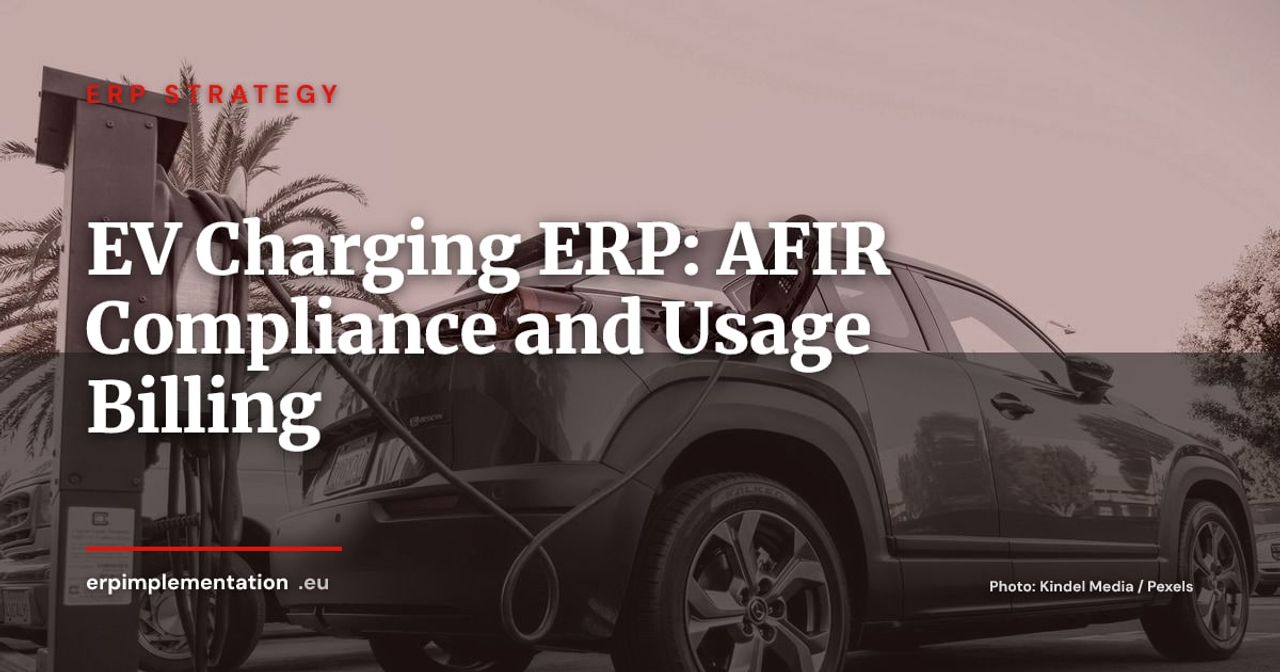
A charging station does not sell a product. It sells thousands of small sessions: a few kilowatt-hours, a few euros, a customer who is often unknown and pays with a bank card or another operator’s badge. For a CFO used to monthly invoices and a few hundred customers, that is a change of business. An ERP built for orders and invoices suddenly faces a volume of micro-transactions it was never designed to absorb on its own.
Since the EU Alternative Fuels Infrastructure Regulation (AFIR, Regulation (EU) 2023/1804) came into application, this business also has its own rules: card payment without a contract, prices shown per kWh, open data. This article is aimed at CFOs and CIOs of charge point operators, fleet managers, local authorities and retailers installing charge points. It describes what the regulation requires, the flows your ERP must handle, a reasonable architecture and the selection criteria.
The amounts quoted below are illustrative cases, built to show mechanisms. They are not market statistics.
A New Business Built on High-Volume Micro-Transactions
Two roles share the value chain, and your ERP does not serve the same one depending on which you hold.
- The CPO (charge point operator) installs, operates and maintains the stations. It sells energy and charger availability. Its customers are passing drivers, e-mobility service providers and sometimes fleets.
- The eMSP (e-mobility service provider) gives the driver a subscription, a badge or an app. It bills the driver, then pays the CPOs whose stations were used.
Many players do both: a retailer that equips its car parks and then offers a card to its customers, for example. The same money then flows in opposite directions depending on the session. When a driver from another network charges at your site, you are the CPO and you bill a third party. When your subscriber charges elsewhere, you are the eMSP and you pay the CPO.
Three immediate consequences for the ERP:
- Volume. Every session produces a consumption record (CDR, charge detail record). A fleet of a few hundred stations quickly generates tens of thousands of lines a month. Nobody keys in or validates that line by line.
- Unit value. A session is worth a few euros. Handling one anomaly (a dispute, a refund, a support call) can cost more than the session’s margin. Normal cases must be processed with no human intervention, and managers should only see the exceptions.
- Many counterparties. Private drivers paying by card, subscribers of third-party eMSPs, company fleets, local authorities that own stations you operate under concession. Each category follows its own billing and collection path.
What AFIR Requires
Regulation (EU) 2023/1804 has applied since 13 April 2024. It sets deployment targets, but the provisions that directly affect an operator’s finance function and information system come down to a few points. Before launching projects, read the text on EUR-Lex and check how it is enforced in each country where you operate: the regulation applies directly, but national authorities organise the monitoring.
Ad Hoc Payment and Displayed Prices
Article 5 requires publicly accessible charge points to allow ad hoc payment, meaning payment without a prior contract with the operator. As we read Article 5, the rules are as follows:
- Points installed after 13 April 2024 must accept electronic payments through a payment card reader or a contactless device. For points below 50 kW, an internet-connected device with a secure payment process (a QR code, for example) can also be enough.
- From 1 January 2027, the obligation also covers points of 50 kW and above on the trans-European transport network (TEN-T) that were installed before 13 April 2024.
For the CFO, the consequence fits in one sentence: you become a retail merchant across a fleet of stations spread over the territory. You have a contract with a payment acquirer, per-transaction fees, refunds, chargebacks, and a reconciliation between what the station measured, what the card was charged and what the bank paid out.
Price Transparency
The regulation requires prices to be reasonable, easily and clearly comparable, transparent and non-discriminatory. For points of 50 kW and above, the ad hoc price is based on a price per kWh of electricity delivered. For points below 50 kW, the components must be shown in a set order: price per kWh, price per minute, price per session, then any other components.
For the ERP, this means your tariff grid is no longer an internal commercial document. It is versioned reference data that must match what the station displays, what the app shows and what the invoice uses. A gap between the displayed price and the billed price is both a customer dispute and a compliance risk.
Data and Interoperability
Article 20 requires operators of publicly accessible points to make static data (location, accepted payment methods, compatibility) and dynamic data (operating status, availability, ad hoc price) available. It provides for a free and unrestricted API, national access points and a common European access point. The deadlines we identified are 14 April 2025 for operators’ data availability and 31 December 2026 for the European access point.
This part belongs mainly to the charging back office, not the financial ERP. But the published price data and the billed price data must come from the same source: that is where the two worlds meet.
The Flows Your ERP Must Absorb
From Charging Sessions to Billing
The usual path is this: the station talks to a central management system (via OCPP, the standard protocol between stations and the central system), which produces one record per session. That system prices the session according to the tariff grid (kWh, minutes, session fees, time-of-day rates), then sends the result to the financial system.
Two principles avoid most nasty surprises:
- Never push a single session into the ERP as an invoice. The ERP receives aggregated entries (by day, by station, by counterparty, by payment method) with a link to the detail kept in the central system.
- Separate pricing from posting. Price calculation happens where the tariffs live. The ERP checks consistency (totals, VAT rates, accounts) and posts.
For one-off card payments, the session receipt can serve as supporting evidence, with an invoice on request. Check with your accountant what form of documentation your country requires.
Roaming and Inter-Operator Reconciliation
Roaming lets a subscriber of one eMSP charge at a third-party CPO. Exchanges between players mostly use the OCPI protocol, or interconnection platforms (hubs) that centralise the relationships. In practice, the CPO sends session records to the eMSP, which validates them and re-bills its own subscriber.
The accounting issue is reconciliation:
- The sessions you issued must match the ones your partner acknowledges. Gaps (rejected session, disputed tariff, duplicate, period cut-off) are the norm at launch.
- Payments arrive in batches, with platform fees and delays. A roaming partner’s customer account must therefore be matched by statement period, not by invoice.
- Credit notes and prior-period adjustments need a clear rule (when to post, at what date).
In the ERP, these counterparties are handled as customers or suppliers with periodic statements, not as thousands of invoices. Automatic matching and bank reconciliation modules are more useful here than the invoicing module.
VAT on Energy and Re-Billing Fleets
Charging is a supply of energy. VAT treatment depends on the country, the customer’s status (business or consumer), how the transaction is classified (supply of electricity or charging service) and where the charging takes place. The rules keep changing and we do not detail them here: have your tax adviser validate them for each country before configuring the ERP.
Whatever the outcome of that analysis, here is what to require from the ERP:
- a VAT code per flow type (one-off card payment, roaming, subscription, fleet) and per country;
- the ability to split the energy part and the service part on the same invoice, if the rule distinguishes them;
- retention of the calculation evidence, useful in case of an audit.
Fleet re-billing is the flow closest to a traditional ERP: a fleet manager receives a monthly statement grouping the sessions of their drivers, by vehicle and cost centre. The challenge is allocation quality: is a badge linked to the right vehicle and the right department? Sessions at the driver’s home reimbursed by the employer are another case, with their own reimbursement and payroll-tax rules, to be handled with payroll and your advisers.
To go deeper on usage-driven revenue, our article on ERP for coworking and flex office describes similar mechanisms: subscriptions, variable consumption, assignment to a customer account.
Fixed Assets and Grants
A charging station is an asset. The ERP must handle:
- Capitalisation: purchase cost, civil works, grid connection, installation, sometimes part of the infrastructure works. The capitalisable scope should be defined with your accountant.
- Components: a station can have a different life cycle from its base (civil works last longer than the electronics). Component accounting applies if your accounting framework provides for it.
- Grants: in France, the Advenir programme funds part of the installation of charge points under conditions. Investment grants have a specific accounting treatment, generally spread over the asset’s depreciation period. Track each file: amount requested, supporting documents, payment date, conditions to meet. Check current conditions with the programme, as they change. Other countries have their own schemes, so map those that apply to you.
For an operator that installs stations at third-party sites (co-owned buildings, companies, local authorities), site and grant-file tracking overlaps with what we cover in our article on ERP for solar PV and energy renovation installers, notably the documents to keep and the tracking of grants receivable in cash forecasts.
Target Architecture: CPO Back Office and Financial ERP
A common mistake is to make the ERP carry the whole chain, from the station to the bank. The opposite mistake is to let the central management system stand in for the accounting. A split of roles that works:
| Component | Role | Example data |
|---|---|---|
| Central management system and CPO back office | Controls the stations (OCPP), prices sessions, manages roaming (OCPI), publishes prices and availability | Sessions, CDRs, tariff grids, station status |
| Payment gateway | Collects card payments, handles refunds and chargebacks | Transactions, fees, payouts |
| Financial ERP | Posts entries, manages customers and suppliers, VAT, fixed assets, grants, cash, reporting | Aggregated entries, statements, assets, grants |
| Customer support tool | Handles disputes and refunds | Tickets, goodwill credits |
What stays outside the ERP: dynamic pricing, fine-grained station management and publication of AFIR data. What must be inside the ERP: the accounting truth, VAT, assets and cash.
The interface contract between the two worlds comes down to three points: a unique session identifier that lets you retrieve the detail, aggregated entries with their grouping rule, and a rejection log that finance reviews every day.
Daily Control Points
- Payment reconciliation: the sum of card-paid sessions against the acquirer’s payouts, net of fees. A persistent gap points to an uncollected session or a duplicate.
- Disputes: track them by reason (unrecognised session, disputed price, faulty station). Without tracking by reason, you will not see that one station or one tariff generates most of the complaints.
- Cash: payouts from acquirers and roaming partners arrive with different delays. A forecast by channel avoids unpleasant surprises, especially when you pre-finance energy purchases.
- ESG reporting: if you track energy delivered by source or by site, make sure the kWh figure is the same one used for billing. Two different measures of the same energy ruin a report’s credibility.
General-Purpose ERP or Specialised Platform: Selection Criteria
| Criterion | General-purpose ERP | Specialised charging platform |
|---|---|---|
| Accounting, VAT, fixed assets, consolidation | Strong point | Limited or absent |
| Station management (OCPP) | Out of scope | Core of the product |
| Roaming and interconnection (OCPI) | Out of scope, or connector to build | Often native |
| Mass billing of micro-sessions | Poorly suited without an aggregation layer | Well suited |
| AFIR compliance (ad hoc payment, prices, data) | Indirect, through entries | Direct |
| Management of installation projects and grants | Good with the project module | Variable |
| Cost and implementation time | Depends on scope | Depends on number of stations |
The conclusion that holds in most cases: both, linked by a clean interface. A specialised platform for operations, and the ERP for finance. If you only have a few stations for your own customers (a retailer, a hotel), an ERP service-billing module may be enough, provided card payment is handled by a specialised provider.
Questions to ask every vendor:
- How do sessions reach the ERP, and in what form (aggregated or individual)?
- What happens when a session is disputed after the accounting close?
- How are the price displayed at the station and the price billed guaranteed to be identical?
- How are roaming partner statements handled and matched?
- What is the proof of compliance for ad hoc payment in each country where you operate?
- Who updates the tax rules, and how often?
Compliance Checklist and 6-Month Plan
Checklist
- Every publicly accessible charge point accepts card or contactless payment (or the device provided for points below 50 kW).
- TEN-T points of 50 kW and above installed before 13 April 2024 are scheduled for compliance by 1 January 2027.
- The per-kWh price is displayed following the presentation rules, and the grid is identical across station, app and invoice.
- Static and dynamic data are published through an API and declared to the national access point.
- A payment acquiring contract and a bank reconciliation process are in place.
- Roaming statements are matched by period, with a process for handling gaps.
- VAT codes by flow and country are validated by a tax adviser.
- Stations are capitalised, with grants tracked file by file.
- A dashboard tracks disputes, reconciliation gaps and cash by channel.
6-month plan
| Month | Goal |
|---|---|
| 1 | Inventory of the fleet, contracts and compliance gaps per station; decision on the target architecture |
| 2 | Mapping of flows (card, roaming, fleets) and VAT codes; tool selection |
| 3 | Sessions-to-ERP interface in aggregated mode, on a pilot site |
| 4 | Reconciliation of payments and roaming statements; rejection log |
| 5 | Fixed assets, grants and management dashboard |
| 6 | Pilot review, rollout to the full fleet, compliance review ahead of the 1 January 2027 deadline |
This timeline assumes a mid-sized fleet. A large or multi-country operator will stage the rollout, but the pilot remains the right first step.
One last point on tax compliance: if your business customers receive invoices, e-invoicing is also a question for you. Our guide on mandatory e-invoicing in France from 1 September 2026 gives the framework to check for your B2B flows, especially fleet re-billing.
Going Further
To better understand usage-based revenue mechanisms, read our article on ERP for coworking and flex office, then compare your candidates with our ERP evaluation grid: 30 criteria scored out of 100 points, to complete with charging-specific requirements (session aggregation, roaming, payment reconciliation). To scope your project or get an opinion on your target architecture, contact us.