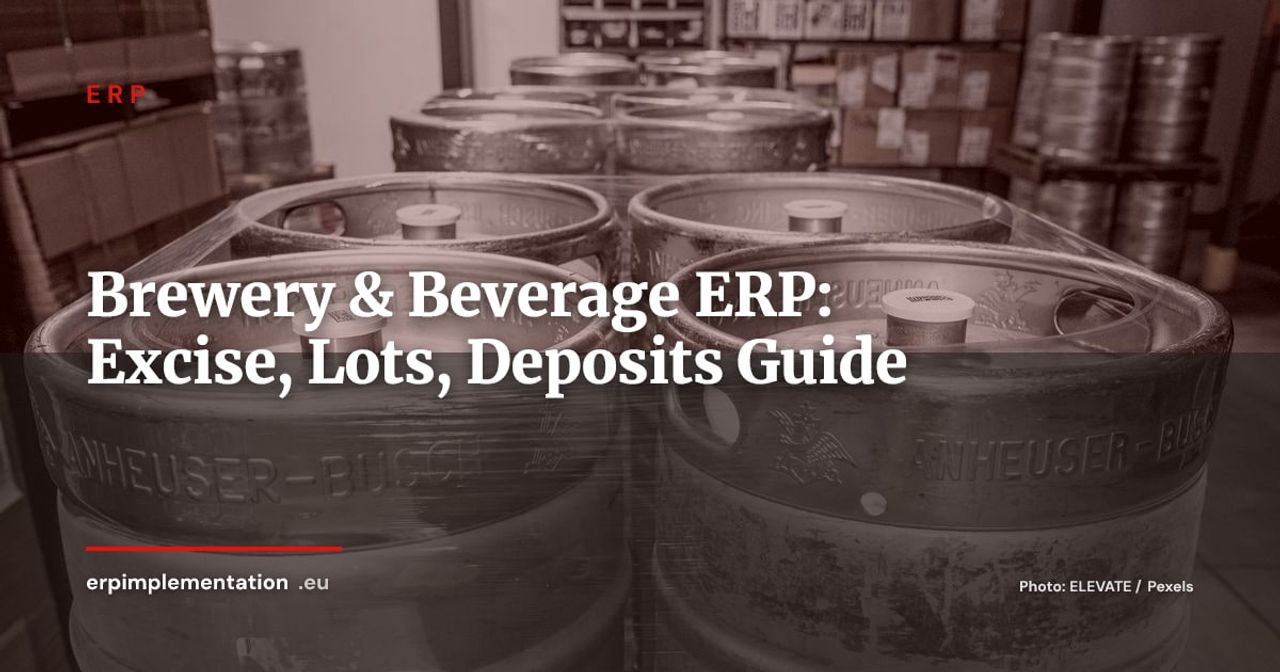
A 15-person craft brewery and a 200-employee bottler have one thing in common: their product is taxed before it is sold, it is measured in hectolitres and degrees, and it travels in containers that may or may not come back. A general-purpose ERP knows nothing about any of this. It handles items, bills of materials and invoices, but not a brew that loses 4% at racking, a deposit-bearing keg or an electronic accompanying document.
This guide is written for finance and operations directors at breweries, cideries, distilleries and bottlers. It explains what the ERP must handle, what is a matter of regulation rather than software, and compares five solution profiles with a recommendation by company size.
Why beverages break general-purpose ERPs
Three characteristics come up in every requirements document.
Tax attaches to the product, not to the sale. Alcoholic beverages are excise goods: the duty becomes chargeable on release for consumption, but while the product sits in a tax warehouse it moves under duty suspension. The ERP therefore has to know the tax status of every unit of stock (suspended or duty-paid) in addition to its logistics status.
Units multiply. The same product is managed in litres, hectolitres, hectolitres of pure alcohol (volume multiplied by alcohol by volume, ABV), bottles, cases, kegs and pallets. An ERP with a single stock unit and a single sales unit linked by a fixed coefficient produces rounding errors that end up in the customs return.
The container is an asset. Kegs, crates, returnable bottles and pallets have a value, a possible deposit and a service life. A general-purpose ERP treats them as sales items, with no return loop and no tracking at the customer site.
General-purpose ERPs can approximate all this through configuration, but maintenance becomes heavy as soon as regulations change. Hence the value of knowing exactly what you expect from the software.
Excise duty and accompanying documents
What is regulation, and what is the ERP’s job
The tax rules are set by legislation and tax authorities. At EU level, the content of the electronic accompanying document is governed by Directive (EU) 2020/262, and the EMCS system is described by the European Commission. Each member state then applies its own rates, thresholds and procedures. For a French producer, for example, the customs administration publishes its guidance on excise goods and the authorised warehousekeeper procedure for production activities (both in French). This article does not replace those texts: rates, thresholds and special cases (small independent brewery relief, exemption schemes) must be checked with your national customs authority.
The ERP does not need to “know the law”. It must:
- carry the authorised warehousekeeper status and split stock by tax warehouse;
- distinguish movements under suspension (electronic administrative document, e-AD) from duty-paid movements (simplified accompanying document in the EMCS framework);
- keep, for every shipment, the document’s administrative reference code (ARC) and the movement status (in progress, received, refused);
- calculate quantities of pure alcohol from measured volume and strength;
- produce the stock statements required in the event of an inspection.
The e-AD is submitted through the national customs portal (GAMMA in France). Ask early: does the vendor offer a direct interface with that portal, a file export that you then key in or re-key, or nothing at all? That is the difference between a two-minute shipment and a daily double entry.
Periodic returns and reconciling tax stock with physical stock
The periodic return rests on a simple balance: opening stock + receipts (production, inbound) - issues (shipments, release for consumption, recorded losses) = closing stock. The trap is reconciliation with the physical inventory.
A good ERP:
- keeps a tax stock separate from the accounting stock, fed by the same movements;
- records losses (breakage, evaporation, racking, samples) with a reason code, because they are declared and audited;
- generates an inventory variance to be approved by a manager, never corrected silently;
- outputs the return data in a directly usable format (in France, filing goes through the customs CIEL online service).
For a finance director the issue is also an accounting one: the excise liability must be accrued at the right time and reconciled to the return. If the accounting module cannot do that, it is one more spreadsheet.
Production and traceability: from brew to product recall
The data model that matters
In a brewery, traceability is a genealogy. A malt lot and a hop lot feed a brew, which becomes one or more fermenters, then a conditioning tank, before being split into packaging lots (bottles, cans, kegs). In a distillery or cidery, blending adds the merging of several lots into one.
The ERP must handle:
- forward and backward traceability: from a bottle back to raw materials, and from a raw material lot to every customer it was shipped to;
- tank-to-tank transfers with loss, because each transfer is a stock transaction;
- blends (several source lots, one target lot, proportions);
- process data: date, gravity, temperature, fermentation time, lab results;
- a versioned recipe, to reproduce a brew or explain a difference in taste.
For food traceability requirements in themselves, see our guide to cold chain, HACCP and temperature monitoring, many of whose principles apply to beverages. For seasonal campaigns and agricultural lot logic, our article on agricultural and cooperative ERP is useful for cideries and producers who process their own harvest.
Example flow: brew, lot, shipment under duty suspension
Take a brewery with authorised warehousekeeper status shipping to an Italian distributor holding an excise number.
- Receipt: 2 malt lots and 1 hop lot enter stock, each with its supplier lot number.
- Brew: the production order consumes the lots, produces a volume of wort and records the original gravity.
- Fermentation and conditioning: the liquid moves to a fermenter, then to a conditioning tank. Each transfer records volume and loss.
- Final ABV: the lab measurement is entered, and the ERP calculates the hectolitres of pure alcohol in the lot.
- Packaging: the tank is racked into 600 kegs and 20 pallets of cans. Each pallet receives a finished-goods lot number linked to the brew.
- Shipment under suspension: the ERP prepares the e-AD data (consignor, consignee, quantities, strength, carrier) for submission through the customs portal. Tax stock stays under suspension until receipt is confirmed.
- Closing the movement: the report of receipt closes the movement. Without it, the tax stock issue stays open.
If the lab finds a defect in a hop lot, the backward query lists the affected brews, finished lots and customers within seconds. This is the test to run in a demo, with your own data.
True production cost
This is the subject that hurts managers most: product cost calculated by hand is almost always wrong. For an ERP, several rules are decisive.
- Process losses: a litre of wort is not a litre of finished product. Losses (sediment, racking, filtration, barrel evaporation for spirits) must be charged to the lot, not smoothed over the year.
- Yield: the gap between the recipe’s theoretical yield and actual yield is the shop floor’s key indicator. The ERP must calculate it brew by brew.
- Excise: depending on whether you reason before or after duty, a product’s margin changes completely. Costing must show both.
- By-products: spent grain, recovered yeast and pomace have a value or a disposal cost. A serious ERP lets you value them as co-products (allocating a share of the cost) or handle them as a secondary recipe.
- Packaging and container costs: caps, labels, closures, cartons and kegs belong in the finished lot’s cost.
- Machine time and labour: absorption on a shared bottling line is based on time spent per lot.
A practical test: ask the vendor to calculate, live, the cost of a brew with a racking loss and a spent-grain valuation, then compare it with your current calculation. If the gap exceeds what your management accounting can explain, it is the calculation that needs revisiting, not just the software.
Packaging, deposits and on-trade, retail and export channels
Managing containers
Kegs, crates and pallets are tracked as container items with their own stock, their own valuation and their own location at the customer. The ERP must:
- record the loan to the customer (keg delivered, keg collected) and the balance per customer;
- invoice the deposit and refund or retain it on return;
- manage washing and reuse cycles if you own the containers;
- separate the container and the contents on a single order line.
Check the rules that apply to beverage packaging in your country: the framework differs from one European country to another, and returnable-packaging deposits do not have the same status everywhere. Do not rely on the software’s behaviour alone.
Pricing by channel
The same product is sold differently in four channels:
| Channel | What the ERP must handle |
|---|---|
| On-trade (pubs, hotels, restaurants) | Kegs, equipment loans, contract discounts, delivery rounds |
| Retail (supermarkets) | Annual terms, palletised logistics, labelling and EDI |
| Specialist shops and resellers | Mix of cartons and units, tiered pricing |
| Export | Duty suspension, e-AD, Incoterms, currencies, destination-country duties |
Channel prices, discounts and deposits must live in a single price grid. Otherwise the sales team negotiates outside the system and management accounting loses sight of the real margin.
Comparing 5 solution profiles
The names below are examples of profiles, not a ranking. Check current functionality directly with vendors and in a demo on your own data.
| Profile | Example | Strengths | Watch points | Target size |
|---|---|---|---|---|
| Open-source ERP with modules | Odoo, micro-brewery industry page and community modules | Low entry cost, native manufacturing and lots, high customisation | Excise and e-AD must be built or bought from an integrator; module quality varies | Micro and small breweries |
| Mid-market ERP | Sage X3 | Solid finance and multi-site, lot traceability | Beverage specifics to configure or develop; check local excise coverage | Multi-entity mid-sized companies |
| Microsoft platform + ISV | Microsoft Dynamics 365 Business Central with an industry extension (for example Aptean Beverage ERP, built on Business Central) | Built-in beverage functions (formulas, lots, alcohol balance, containers), Microsoft ecosystem | Licence and partner costs; check regulatory coverage in your country | SMB to mid-market |
| Vertical beverage software | Dedicated brewery and distillery software (for example Breww or Ekos Brewmaster, depending on the market) | Covers production, excise and stock from day one | Accounting often limited; geographic scope to verify | Micro to small breweries |
| Food and process-industry ERP | Process ERP for food and beverage | Recipes, yields, lots, quality | May be oversized for a small business | Industrial bottler |
Recommendation by size
- Micro-brewery (under 15 employees): a vertical beverage solution, or Odoo with an integrator that has already delivered an excise project in your country. The deciding criterion is the e-AD and the return, not finance.
- Brewery or cidery with 15 to 60 employees: a well-integrated Odoo, or Business Central with a beverage extension. The choice depends on your internal capacity to carry a project and on the partner ecosystem in your region.
- Industrial bottler or multi-site group (60 to 250 employees): Business Central with an industry extension, Sage X3 or a food-process ERP. At this level, financial consolidation, bottling lines and multi-site costing weigh more than ease of use.
For a similar comparison logic in another regulated sector, see our ERP comparison for viticulture, which also covers vintage tracking and customs returns.
Migration pitfalls
ERP migrations in beverages rarely fail on finance. They fail on three subjects.
- Opening tax stock: the opening balance must match the last return exactly. Plan a cut-over date at the start of a reporting period and a joint stocktake the day before.
- Lot history: traceability and record-keeping obligations require you to be able to retrieve old lots. Either you migrate the genealogy, or you keep the old system read-only. Decide before signing the contract.
- Containers at customer sites: the balance of kegs and crates per customer is rarely kept cleanly. Run a customer-by-customer count before go-live, otherwise the ERP starts with wrong balances.
On top of this comes dual running: during cut-over, you must never submit the same e-AD from two systems.
Selection checklist: 10 questions
- Does the software handle authorised warehousekeeper status and a dual view of tax stock and accounting stock?
- How is the e-AD submitted: direct interface with the customs portal, file, or manual entry?
- Is the periodic return produced from movements and reconciled with the inventory?
- Are hectolitres of pure alcohol calculated automatically from volume and strength?
- Can a lot’s full genealogy be queried in both directions, in a demo, on your data?
- Are process losses charged to the lot, with a reason code?
- Can by-products (spent grain, yeast) be valued as co-products?
- Do containers (kegs, crates, pallets) have stock, a deposit and a balance per customer?
- Are channel price grids (on-trade, retail, export) managed in a single repository?
- Is a customer in your country, in the same sector and of similar size, willing to talk to you about their project?
Score each vendor on these ten points before comparing prices: licence differences are generally smaller than integration cost differences.
Going further
Download our 100-point ERP evaluation grid to compare three vendors side by side on the criteria above, or contact us to scope your project with an independent view.